
Taper rollers and cylindrical rollers are widely used in industrial bearing applications, but their different geometries make them suitable for different operating conditions. Choosing between them requires more than comparing roller dimensions or load ratings. Engineers must consider load direction, bearing arrangement, rotational speed, installation space, and operating environment.
Taper rollers are commonly used in applications involving combined radial and axial loads, while cylindrical rollers are generally selected for high radial load capacity and bearing stiffness. Their performance also depends on the internal bearing configuration and mounting conditions.
For bearing manufacturers, OEMs, distributors, and purchasing professionals, understanding the differences between taper roller vs cylindrical roller designs helps identify suitable components, evaluate technical specifications, and reduce selection risks.
1. What Are Taper Rollers and Cylindrical Rollers?
The primary difference between these two rolling elements is their geometric profile, which determines how they interact with bearing raceways.
Taper Rollers
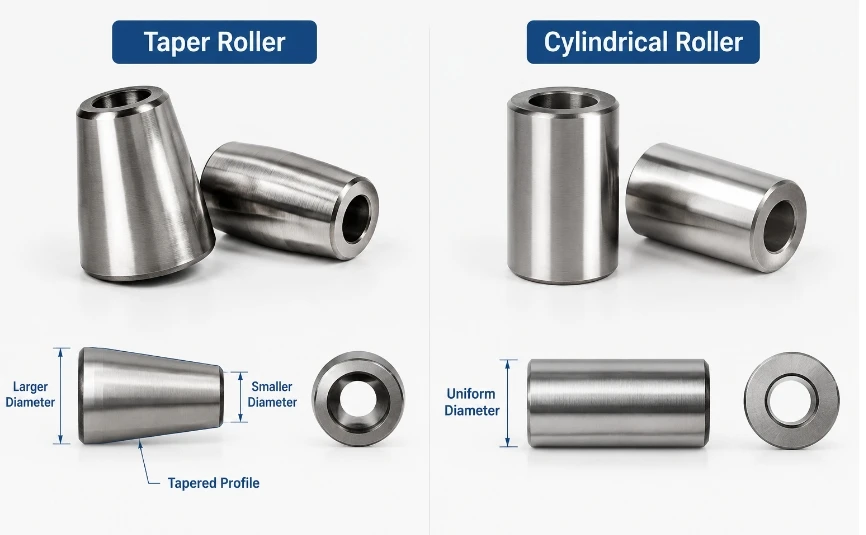
Taper rollers have a truncated cone-shaped profile, with different diameters at the two ends. They are designed to operate between angled raceways in tapered roller bearings.
The contact lines between the rollers and raceways converge toward a common point on the bearing axis. This arrangement allows the bearing to transmit radial and axial forces simultaneously.
Taper rollers are commonly found in automotive wheel hubs, transmissions, construction machinery, and heavy-duty gearboxes. Their geometry is particularly useful when applications require combined load support and accurate shaft positioning.
Roller angle, end geometry, dimensional accuracy, and surface finish all influence contact conditions and bearing performance.
Cylindrical Rollers
Cylindrical rollers have a straight profile with a relatively uniform diameter along their length. They operate between cylindrical raceways and provide line contact under radial loading.
Their geometry allows loads to be distributed along the roller length, making them suitable for applications requiring high radial load capacity and stiffness.
Cylindrical rollers are commonly used in electric motors, industrial gearboxes, machine tools, pumps, and heavy industrial equipment.
Depending on the bearing configuration, cylindrical roller bearings can also accommodate axial displacement or limited axial loads.
2. Taper Roller vs Cylindrical Roller: Key Differences
Although both roller types use line contact, their geometry and bearing arrangements produce different load-handling characteristics.
| Comparison Factor | Taper Rollers | Cylindrical Rollers |
|---|---|---|
| Geometry | Truncated cone-shaped | Straight cylindrical |
| Contact Arrangement | Angled raceway contact | Cylindrical raceway contact |
| Primary Load Capability | Combined radial and axial loads | Primarily radial loads |
| Axial Load Support | Designed for axial loads in the bearing arrangement | Depends on flange configuration |
| Radial Load Capacity | High, depending on design | High to very high, depending on design |
| Bearing Arrangement | Often paired or opposed | Available in several flange configurations |
| Typical Applications | Wheel hubs, transmissions, heavy machinery | Motors, gearboxes, machine tools |
Load direction and contact geometry
Taper rollers operate at an angle relative to the bearing axis. This allows tapered roller bearings to accommodate combined radial and axial loading. However, a single-row tapered roller bearing generally supports axial loads in one direction, so paired arrangements may be required for bidirectional axial loading.
Cylindrical rollers primarily transmit radial forces. Their axial load capability depends on the bearing's flange arrangement rather than the roller geometry alone.
Design flexibility
Both roller types are available in different dimensions and precision levels. Their suitability depends on the complete bearing design, including raceway geometry, roller quantity, internal clearance, and operating conditions.
For more information about individual taper roller specifications and industrial applications, see our Taper Rollers: Selection Guide for Industrial and Automotive Bearing Applications.
3. Differences in Load Capacity and Operating Performance
Load capacity and operating performance should be evaluated according to the actual forces, rotational speed, and bearing arrangement.
Radial and Axial Load Capacity
Tapered roller bearings are designed to support combined radial and axial loads. Their contact angle influences the relationship between radial and axial load capacity. A larger contact angle generally increases the bearing's ability to accommodate axial loads, although it also affects other operating characteristics.
When axial forces act in both directions, two tapered roller bearings may be arranged face-to-face or back-to-back. The mounting arrangement and preload must be considered to achieve the required operating performance.
Cylindrical roller bearings are primarily designed for radial loading. Their relatively large contact area makes them suitable for heavy radial loads and applications requiring high stiffness.
However, axial displacement and axial load capability vary by bearing design. For example:
-
NU and N configurations: Allow axial displacement between the inner and outer rings within the bearing.
-
NJ configurations: Can provide axial location in one direction and accommodate limited axial loads.
-
NUP configurations: Can provide axial location in both directions through their flange and loose flange ring arrangement.
These structural differences are important when selecting cylindrical roller bearings for rotating shafts and industrial equipment.
Speed, Friction, and Operating Temperature
Cylindrical roller bearings are often suitable for high-speed applications when their internal design, lubrication, and operating conditions are appropriate.
Tapered roller bearings involve additional sliding components at the roller-rib contact, making lubrication, preload, and mounting accuracy particularly important.
For both types, excessive preload, insufficient lubrication, or poor alignment can increase friction and temperature. Actual speed limits should therefore be checked against manufacturer specifications rather than assuming one roller type is always faster.
4. Typical Applications of Taper Rollers and Cylindrical Rollers
Application requirements provide a practical basis for understanding which roller type is more suitable.
Taper Roller Applications
Taper rollers are frequently used where combined radial and axial forces occur.
-
Automotive wheel hubs: Support vehicle weight, cornering forces, and axial loading. Paired tapered roller bearings are commonly used to provide the required load support and adjustment.
-
Automotive transmissions: Accommodate combined loads generated by rotating shafts and gear systems.
-
Construction machinery: Support heavy operating loads in equipment exposed to vibration and changing working conditions.
-
Agricultural machinery: Provide load support for rotating components operating under variable conditions.
-
Industrial gearboxes: Help maintain shaft positioning under combined loading.
Cylindrical Roller Applications
Cylindrical rollers are generally preferred where radial load capacity and stiffness are primary requirements.
-
Electric motors: Support rotor loads and maintain stable shaft operation.
-
Industrial gearboxes: Accommodate radial forces generated by gear transmission.
-
Machine tools: Support rotating shafts and components requiring dimensional stability.
-
Pumps and compressors: Handle radial loading during continuous operation.
-
Heavy industrial equipment: Support rotating assemblies under substantial radial loads.
The bearing configuration must still match the application's axial displacement, speed, and lubrication requirements.
For further information about cylindrical roller specifications and industry applications, see our Cylindrical Rollers: Selection Guide for Industrial and Wind Power Applications.
5. How to Choose Between Taper Rollers and Cylindrical Rollers
Selecting the appropriate roller type requires evaluating the complete operating requirements rather than focusing on a single performance characteristic.
1. Load Direction and Magnitude
Determine whether the application involves radial loads, axial loads, or combined loading. Tapered roller bearings are suitable for combined loading, while cylindrical roller bearings are generally preferred when high radial load capacity is the main requirement.
2. Bearing Configuration
Consider whether the shaft requires axial positioning in one or both directions. Paired tapered roller bearings and different cylindrical roller bearing configurations provide different axial locating and displacement capabilities.
3. Operating Speed and Lubrication
Evaluate rotational speed, duty cycle, lubrication method, and expected operating temperature. These factors influence friction, heat generation, and service life.
4. Installation Space and Dimensional Requirements
Check shaft diameter, housing dimensions, bearing width, and available mounting space. Roller diameter, length, profile, and tolerances must match the intended bearing design.
5. Operating Environment and Maintenance
Temperature, contamination, moisture, vibration, and maintenance intervals should be considered when determining material, surface quality, and lubrication requirements.
For applications involving heavy combined loading, roller geometry, contact angle, and load distribution require more detailed engineering evaluation. Our guide on How to Select Taper Rollers for Heavy-Load Bearing Applications provides additional information.
6. What Should Buyers Consider When Sourcing Bearing Rollers?
For OEM manufacturers, distributors, and industrial buyers, roller quality and manufacturing consistency are important considerations when evaluating suppliers.
Material Selection
High-carbon chromium bearing steel, such as GCr15, is commonly used for precision bearing rollers. Material selection should consider hardness, heat treatment, fatigue resistance, and operating conditions.
Dimensional and Geometric Accuracy
Important specifications include roller diameter, length, taper angle, diameter variation, and profile accuracy. For taper rollers, the accuracy of the tapered profile and end geometry directly affects contact conditions.
Surface Quality and Manufacturing Consistency
Surface roughness, roundness, cylindricity, and dimensional consistency influence contact performance and bearing operation. Buyers should evaluate the supplier's machining processes and inspection procedures.
Information Required for an RFQ
When requesting a quotation for standard or customized bearing rollers, buyers should prepare:
-
Roller type and intended application
-
Roller diameter, length, and profile requirements
-
Taper angle, where applicable
-
Material and hardness specifications
-
Dimensional and geometric tolerances
-
Technical drawings or existing samples
-
Estimated order quantity and purchasing frequency
Complete technical information helps suppliers assess manufacturing feasibility, identify potential production limitations, and provide more accurate quotations.
7. Conclusion: Which Roller Type Is Right for Your Application?
Taper rollers and cylindrical rollers serve different bearing requirements. Taper rollers are suitable for applications involving combined radial and axial loads, while cylindrical rollers are generally preferred for high radial load capacity and stiffness.
The final choice depends on bearing configuration, load direction, operating speed, installation space, and lubrication conditions.
For standard or customized bearing roller requirements, buyers can submit technical drawings, samples, or existing specifications for evaluation. Providing material, dimensional tolerance, and order quantity details also helps suppliers assess manufacturing feasibility and prepare an accurate quotation.
Need Help Selecting the Right Bearing Rollers?
If you're sourcing standard or custom bearing rollers for a new project or replacement application, our engineering team can help evaluate your requirements before production.
Simply share your technical drawing, existing sample, roller dimensions, material requirements, or application details, and we'll review the specifications to recommend a suitable solution for your operating conditions.
Whether you need taper rollers, cylindrical rollers, or non-standard OEM components, we can support prototype development, volume production, and technical discussions for your project.
Request a Quote | Discuss Your Roller Requirements | Submit Your Drawing