
Cylindrical Rollers: Selection Guide for Industrial and Wind Power Applications
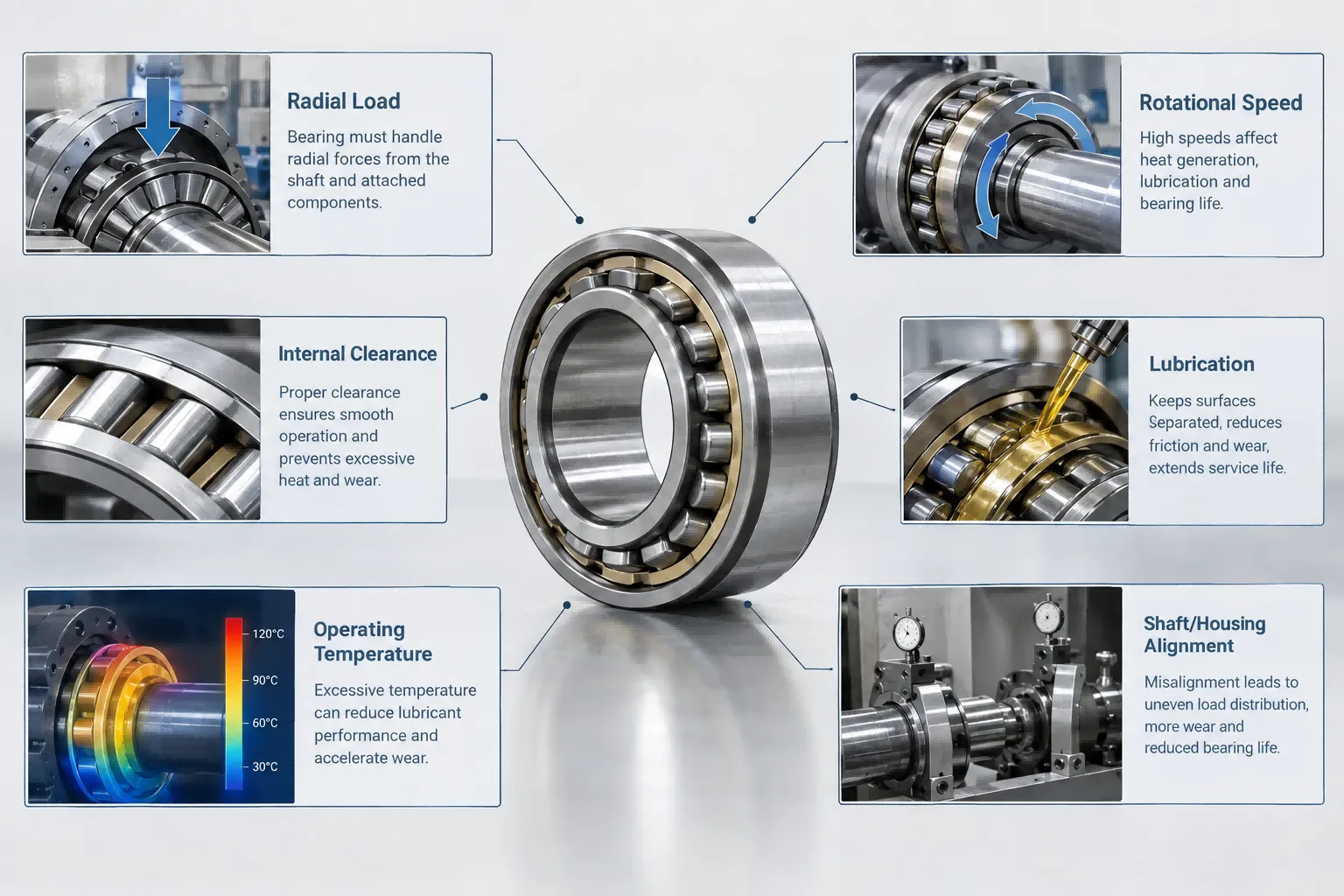
Selecting cylindrical rollers for a gearbox, motor, generator, or wind turbine requires more than matching bearing dimensions. Radial load, rotational speed, operating clearance, lubrication, temperature, shaft movement, and housing conditions can all affect the required design.
For engineers and purchasing teams, the objective is to match the roller or cylindrical roller bearing to the actual operating conditions rather than select a replacement based only on bore, outside diameter, and width. This guide explains the main selection factors, bearing arrangements, wind power applications, common failure symptoms, and technical information needed for standard or custom sourcing.
Why Cylindrical Rollers Suit Heavy-Duty Applications
Cylindrical rollers provide line contact with the raceway, allowing cylindrical roller bearings to support substantial radial loads while maintaining high radial stiffness. They are commonly considered for industrial gearboxes, electric motors, generators, machine tools, and other equipment where radial loading is significant.
The internal bearing design is equally important. Different configurations control how the bearing accommodates axial displacement, locates the shaft, and handles operating conditions.
For buyers evaluating cylindrical roller products, the first step is therefore to identify the bearing's mechanical function within the assembly before selecting the final specification.
How to Select a Cylindrical Roller Bearing
1. Radial Load
Start with the actual load profile rather than only the machine's rated load.
Consider:
-
Continuous radial load
-
Peak or shock load
-
Load variation
-
Required service life
-
Minimum load conditions where applicable
For gearboxes and other variable-load machinery, torque and gear forces can change during operation. The bearing load rating should therefore be evaluated together with the duty cycle.
2. Operating Speed
Speed affects roller dynamics, cage behavior, friction, heat generation, and lubrication requirements.
For a high-speed cylindrical roller bearing, check:
-
Maximum and continuous speed
-
Cage design
-
Lubricant viscosity
-
Operating temperature
-
Internal clearance
-
Acceleration and deceleration
A design optimized for maximum radial capacity is not automatically the right choice when high rotational speed is the main requirement.
3. Internal Clearance
Internal clearance changes after the bearing is installed.
A useful engineering relationship is:
Initial clearance + shaft/housing fit + temperature effects → operating clearance
An interference fit can reduce clearance, while differences in inner- and outer-ring temperature can change it further.
C2, CN, C3, and other clearance classes should therefore be selected from the actual fit, load, speed, and temperature conditions. C3 should not be treated as a universally better option than normal clearance.
4. Lubrication
Lubrication must match the bearing's load, speed, temperature, and maintenance conditions.
Common methods include:
-
Grease
-
Oil bath
-
Circulating oil
-
Oil-air lubrication
For high-speed applications, lubricant viscosity and heat removal become particularly important. In heavily loaded applications, the lubricant must also maintain an adequate film between the rolling contacts.
Lubrication should therefore be considered during bearing selection rather than after the bearing specification has already been finalized.
5. Temperature and Environment
Operating temperature affects lubricant viscosity, internal clearance, dimensional stability, and material performance.
Provide the expected:
-
Ambient temperature
-
Bearing operating temperature
-
Temperature peaks
-
Cooling conditions
-
Contamination or moisture exposure
For custom cylindrical rollers, an actual operating temperature range is more useful than a general description such as “high temperature.”
6. Shaft, Housing, and Misalignment
The bearing operates as part of a complete mechanical assembly.
Shaft deflection, housing deformation, mounting accuracy, and misalignment can change the load distribution between rollers and raceways. Excessive edge loading can then increase localized stress and surface damage.
For highly loaded or flexible structures, shaft and housing fits, runout, alignment, and deformation should be included in the engineering review.
How to Match the Bearing to the Application
The selection priority changes with the machine's operating conditions.
| Application Condition | Main Selection Focus |
|---|---|
| High radial load | Roller capacity, bearing load rating, service life |
| High speed | Cage design, lubrication, heat generation |
| Thermal expansion | Axial displacement and bearing arrangement |
| Shaft locating requirement | NJ or NUP-type arrangement where appropriate |
| Shaft deflection | Alignment and roller profile |
| High temperature | Material, heat treatment, lubricant, clearance |
| Wind turbine gearbox | Load cycle, speed, lubrication, clearance |
This approach helps avoid selecting a bearing from a single parameter. A high load rating, for example, does not compensate for unsuitable clearance, lubrication, or axial location.
Choosing the Cylindrical Roller Bearing Arrangement
Different cylindrical roller bearing designs provide different axial functions.
| Design | Typical Function |
|---|---|
| NU | Radial load with axial displacement |
| N | Radial load with axial displacement |
| NJ | Radial load with axial location in one direction |
| NUP | Radial load with axial location |
| NN | High radial stiffness and load capacity |
The exact arrangement depends on whether the shaft needs to float axially or be located by the bearing.
This is particularly important where thermal expansion occurs. A locating and floating arrangement can allow controlled axial movement without transferring unnecessary axial force into the bearing system.
When Should You Choose Cylindrical Rollers?
Cylindrical rollers are not automatically the correct choice for every heavy-load application. The load direction, axial movement, misalignment, speed, and assembly design should determine the bearing type.
| Requirement | Cylindrical Roller | Spherical Roller | Tapered Roller |
|---|---|---|---|
| High radial load | Strong fit | Strong fit | Strong fit |
| Axial displacement | Available with suitable designs | Arrangement dependent | Generally limited |
| Misalignment | Application dependent | Generally higher tolerance | Application dependent |
| Radial stiffness | High | High | High |
| Typical applications | Gearboxes, motors, generators | Heavy machinery | Hubs, gearboxes, heavy machinery |
This comparison is a starting point rather than a universal ranking. The final choice should be based on the actual load direction, shaft movement, alignment, speed, and required service life.
Cylindrical Roller Bearings for Wind Power Applications
Wind turbine drivetrains combine variable loads, torque changes, speed variation, lubrication requirements, and long service intervals. Cylindrical roller bearings are used in selected gearbox and drivetrain positions where high radial load capacity and controlled axial movement are required.
For cylindrical roller bearings for wind turbines, engineers should evaluate the specific bearing position rather than treat the entire turbine as one operating condition.
Gearbox
Important factors include:
-
Variable torque and radial load
-
Rotational speed
-
Lubrication and oil cleanliness
-
Roller and cage dynamics
-
Internal clearance
Generator
Selection may focus more heavily on speed, temperature, vibration, lubrication, and electrical operating conditions.
Drivetrain
The review may include radial and axial loads, shaft deflection, thermal movement, alignment, and bearing arrangement.
High-capacity cylindrical roller designs may be considered where radial load capacity is a major constraint. However, increasing capacity does not automatically make a bearing suitable for every shaft position. Internal geometry, lubrication, speed, and operating clearance still need to be evaluated.
What Does a Failed Cylindrical Roller Bearing Tell You?
A failed bearing can provide useful information for selecting its replacement.
| Failure Symptom | Possible Factors to Check |
|---|---|
| Spalling | Load, fatigue life, lubrication, contamination |
| Smearing | Sliding, speed/load combination, lubrication |
| Overheating | Clearance, speed, lubrication, preload, cooling |
| Edge damage | Misalignment, shaft deflection, housing deformation |
| Cage damage | Speed, acceleration, lubrication, installation |
| Surface wear | Contamination, inadequate lubrication, sliding |
The original bearing should not automatically be replaced with exactly the same specification after premature failure. Reviewing the damage pattern together with load, speed, lubrication, fit, and operating conditions can identify whether the original specification or the operating environment contributed to the problem.
What Information Should Be Included in a Cylindrical Roller RFQ?
Basic information: Bearing type, part number, bore, outside diameter, width, quantity, and drawing if available.
Operating information: Radial load, speed range, temperature, lubrication, shaft/housing fit, axial movement, and expected service life.
Quality and inspection requirements: Specify dimensional tolerances, internal clearance, material and heat-treatment requirements, surface finish, inspection standards, and any required inspection reports. For OEM or critical applications, it is also useful to define batch traceability and acceptance criteria in advance. See our [Quality Control] process for more information.
Custom project information: Non-standard dimensions, roller profile, precision class, special materials, or additional inspection requirements.
For a replacement project, a sample or drawing can provide a useful starting point when the original bearing designation is unavailable.
Custom Cylindrical Rollers for OEM Applications
Standard catalogue dimensions may be sufficient for direct replacement, but OEM applications can require tighter control of roller geometry and material properties.
Custom requirements may include:
-
Non-standard dimensions
-
Diameter variation
-
Roundness
-
Roller profile
-
Surface roughness
-
Material
-
Heat treatment
-
Dimensional tolerance
Two rollers with the same nominal diameter can behave differently if their profile, roundness, surface finish, or diameter variation differs. For this reason, a custom project should begin with the application requirements and existing component information rather than price alone.
For custom cylindrical rollers for OEM or replacement applications, drawings, samples, operating data, and quantity requirements provide a practical basis for technical evaluation.
FAQ
What are cylindrical rollers used for?
Cylindrical rollers are used in bearing assemblies requiring substantial radial load capacity and stiffness. Common applications include industrial gearboxes, motors, generators, machine tools, and selected wind turbine drivetrain positions.
How do I select a cylindrical roller bearing?
Start with radial and axial loads, speed, operating temperature, lubrication, internal clearance, shaft and housing fits, alignment, and the required axial bearing arrangement.
What clearance should a cylindrical roller bearing have?
The required clearance depends on operating temperature, interference fits, speed, load, and the bearing arrangement. CN, C3, or other clearance classes should be selected from the actual application conditions.
Are cylindrical roller bearings suitable for wind turbine gearboxes?
They are used in selected wind turbine gearbox and drivetrain positions. The appropriate design depends on shaft position, load cycle, speed, lubrication, clearance, and axial movement requirements.
What information is needed for a custom cylindrical roller RFQ?
A drawing or sample, dimensions, material, tolerance, load, speed, temperature, lubrication, application, and required quantity provide the main information needed for technical evaluation.
Conclusion
Cylindrical roller selection should be based on the complete operating condition rather than dimensions or load rating alone.
For industrial machinery, the main considerations are load, speed, clearance, lubrication, temperature, fit, alignment, and bearing arrangement. For wind turbine applications, the specific drivetrain position and operating cycle also need to be considered.
For OEM and replacement projects, a drawing or sample combined with actual operating data provides a stronger basis for selecting or customizing the cylindrical roller bearing.