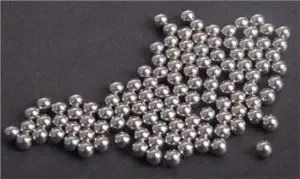
Main factors affecting vibration and noise of bearing and countermeasures to reduce the noise and abnormal sound of steel ball bearing.
Abstract: with the continuous progress of manufacturing technology in China's bearing industry, the production of low-noise and noise free bearings has become the goal of professional bearing manufacturers. The influence of bearing vibration and noise is more important. The main factors affecting the vibration and noise of steel ball bearing are analyzed.
Key words: steel ball quality; Bearing; Influence of vibration value
With the continuous progress of manufacturing technology in China's bearing industry, the production of low-noise and noise free bearings has become the goal of professional bearing manufacturers. The influence of bearing vibration and noise is more important. Over the years, our factory has made a lot of analysis and Research on the causes of steel ball affecting bearing vibration, noise and abnormal sound in the practice of bearing sleeve installation. The main influence factors of bearing vibration and noise are as follows:
1. Main factors affecting vibration and noise of steel ball bearing
1.1 Surface quality of steel ball
The surface quality of steel ball is the root cause of bearing vibration, noise and abnormal sound. A large number of experimental studies show that the influence ratio of outer ring raceway surface, inner ring raceway surface and steel ball surface on bearing vibration, noise and abnormal sound is 1:3:10. The surface defects of steel ball include scratch, group point, pit, single point, scratch, small flat top, etc. When the defect is large and deep, it will cause high vibration value and noise of bearing sleeve. When the defect is small and shallow, the vibration value of bearing sleeve is low, and sometimes abnormal sound of bearing occurs. The surface quality of the steel ball is large, and the deep defects are deep scratches, coarse stripes, coarse wheat grains, group points, pits, small flat tops, etc. The noise and abnormal sound generated by the bearing due to the surface quality of the steel ball are non-periodic. At this time, the sound generated is harsh intermittent and continuous low-frequency sound.
1.2 Spherical error of steel ball
The spherical error of steel ball mainly affects the low-frequency vibration and noise of bearing. According to the regularity of steel ball movement and the randomness of abrasive and grinding disc participating in cutting, the steel ball gradually approaches the ideal ball from effective cutting one at a time. The spherical error of steel ball is affected by the original accuracy of steel ball incoming materials, the accuracy and vibration of machine tool spindle, the fitting degree between grinding plate groove r arc and steel ball, the inconsistency of grinding disc groove r arc depth, the non-uniformity of abrasive and the instability of personnel operation. There are great differences in the spherical error of steel ball. When the ultra-precision grinding process allowance of the steel ball is too large, or the original accuracy of the steel ball is poor, the inconsistency between the steel ball and the R-arc of the grinding plate groove, and the greater the deformation of the steel ball and the R-arc of the grinding plate groove, the greater the spherical error of the steel ball. The greater the spherical error of the steel ball, the greater the low-frequency vibration and noise produced by the bearing.
1.3 Surface roughness and waviness of steel ball
The surface roughness of the steel ball makes the bearing produce abnormal sound of composite frequency, and the surface waviness affects the bearing to produce high-frequency vibration and noise. The surface roughness and waviness of steel ball are directly related to the processing technology and processing conditions of steel ball. When the surface roughness of the steel ball is small, its influence on the vibration and noise of the bearing is not obvious. When the surface roughness of steel ball Ra≤ 0.01 μ m, Ry≤0.1 μ, the bearing sleeve basically has no abnormal sound, and the effect is good. When the density of the surface waviness of the steel ball is basically uniform, the vibration and noise of the steel ball sleeve is stable and basically free of abnormal sound. The dense area of the steel ball waviness is more likely to cause abnormal sound of the bearing than the sparse area.
1.4 Cleanliness of steel ball surface
When the steel ball surface is unclean or stained with small foreign matters, it is easy to cause noise and abnormal sound after the bearing is sleeved. When the steel ball surface is unclean or stained with small impurities, the bearing will produce aperiodic noise and abnormal sound as if there are large surface defects on the steel ball surface after the bearing is sleeved.
2. Countermeasures to reduce the noise and abnormal sound of steel ball bearing
2.1 Improve the rigidity and accuracy of steel ball processing machine tools
The rigidity and accuracy of the steel ball processing machine tool have a direct impact on the spherical error, surface roughness, waviness and other quality indexes of the steel ball. It is necessary to scientifically improve the rigidity of the machine tool, take active vibration isolation and absorption measures, and absorb most of the vibration energy of the machine tool. At the same time, improve the accuracy level of the spindle transmission gear, bearing and assembly of the machine tool, ensure the machining accuracy of the machine tool, and provide a basic guarantee for vibration and noise reduction after the steel ball is sleeved. After the machine tool is installed, the radial runout of the grinding plate shall be controlled within 0.02mm and the axial runout shall be controlled within 0.03mm.
2.2 Scientific formulation of steel ball processing technology
Scientific and reasonable processing parameters and processes are an important guarantee for vibration and noise reduction after steel ball is sleeved. In the steel ball processing and production, the active use of new industrial processes and technologies has an obvious effect on the vibration and noise reduction after the steel ball is sleeved, such as the use of steel ball surface strengthening treatment process, resin grinding wheel grinding process, etc. In particular, the use of steel ball surface strengthening treatment process has significantly improved the vibration and noise reduction of steel ball. After the surface strengthening treatment of the steel ball, a hard metamorphic layer is produced on the surface of the steel ball, and its surface hardness is 2 ~ 3HRC higher than that of the base metal, which obviously enhances the anti-collision and anti- friction ability of the steel ball surface, which is conducive to improving the surface quality of the steel ball. The wear resistance of the steel ball can be increased by 1.5 ~ 2 times, and the vibration value of the steel ball can be reduced by 4 ~ 6 dB after the steel ball is sleeved; At the same time, due to the improvement of the anti-collision and anti-friction ability of the steel ball, the noise of the steel ball after being sleeved is also significantly improved. On the other hand, the quality of incoming materials before ultra-precision grinding of steel balls should be strictly controlled, and its quality accuracy should reach or approach the national standard G16 grade standard. The amount of superfinishing should be small, which is generally controlled at 1 ~ 2 μm, ensure that the steel ball is in good agreement with the R arc of the grinding plate groove, so as to ensure that the steel ball can obtain ideal spherical error, surface roughness, waviness, etc.
2.3 Strictly control the processing conditions such as abrasive and grinding disc
Abrasive is the main medium of steel ball grinding. The steel ball can be micro cut under the action of abrasive, and finally achieve the ideal machining accuracy. Generally, clean and uniform Abrasives shall be selected after channeling and precipitation to ensure that most abrasive particles are within 0.5 μm or less, during ultra-precision grinding, the steel ball can obtain better surface quality, surface roughness and waviness. After the steel ball is sleeved, it can achieve ideal effect of vibration and noise reduction.
The grinding plate plays the role of grinding carrier embedded with abrasive in the process of superfinishing. The selection of grinding disc with fine and uniform structure, suitable hardness, no sand holes, pores and hard spots, and good inlaying performance is the premise to ensure the uniform cutting of each surface of each steel ball in the forming process of grinding plate groove R-arc and steel ball. The hardness of the grinding disc is generally controlled in the range of HRB170-210. When the steel ball specification is small, the grinding disc with relatively hard hardness is preferred. When the steel ball specification is large, the grinding disc with relatively soft hardness is preferred.
2.4 Adjust the ball output reasonably to ensure that the R-arc depth of the grinding groove is consistent
The key to obtain ideal spherical error and surface quality of steel ball is to reasonably adjust the ball in and out of the machine tool and ensure the consistent R-arc depth of grinding groove.
In terms of ball inlet and outlet of vertical machine tool, by adjusting the ball inlet and outlet, it can basically ensure that the number of steel balls entering the channel for grinding per unit time is directly proportional to the central diameter length of the channel, that is, the R-arc depth of the grinding plate groove is basically the same. When the steel ball enters the machine tool, there are obvious differences in the quality of the steel ball at the back of the machine tool. At the same time, it is inevitable that the steel ball will stay at the back of the machine tool according to the characteristics of the steel ball entering the machine tool. Therefore, when machining steel balls with vertical machine tools, it is necessary to reduce vibration and noise, and the key to ensure the consistent R-arc depth of grinding groove is to ensure the smooth ball delivery and full exchange of steel balls at the ball outlet.
In terms of ball in and out of the horizontal machine tool, the number of steel balls entering each channel for grinding per unit time is basically the same, that is, the weight of steel ball chips ground in each channel per unit time is basically the same. The diameter of the innermost groove is shorter than that of the outermost groove, so the inner groove is easy to grind deeper than the outer groove. The depth difference between the innermost ditch and the outermost ditch is the largest. In the ball outlet, the processed steel ball flows into the material tray smoothly under the guidance of the ball receiving knife plate. At the same time, the steel balls inside and outside the material tray shall be exchanged once every 1 turn of the material tray. Therefore, the horizontal machine tool should reduce vibration and noise when processing the steel ball, and the key to ensure the consistency of the R-arc depth of the disc groove is to ensure that the steel ball is adjusted at the ball inlet and outlet according to the length of the grinding plate groove, and the number of grinding plate grooves can be appropriately reduced to reduce the length difference between the innermost groove and the outermost groove.
According to the characteristics of vertical machine tools and horizontal machine tools, it is necessary to reasonably adjust the ball in and out quantity of steel balls to ensure the consistent R-arc depth of disc groove. In terms of steel ball processing specifications, vertical machine tools are more suitable for processing steel balls with smaller specifications, and horizontal machine tools are more suitable for processing steel balls with larger specifications.
2.5 Cleaning and protection of steel ball after dropping
After the steel ball passes the processing and inspection, it is easy to ignore the problem of cleaning and protection. After the steel ball is processed, the surface quality and geometric accuracy are high, which is easy to reduce the accuracy under the damage of external forces and impurities. Therefore, in the process of steel ball cleaning, the environment should be clean and less dust. Soft materials shall be used to isolate the contact with the steel ball and cleaned. Handle with care in the process of handling and transportation to prevent collision and extrusion, which can effectively maintain the accuracy and quality of the steel ball and reduce the vibration and noise impact on the bearing after the steel ball is sleeved. Responsible editor: Yang Fan Abstract: with the continuous progress of manufacturing technology in China's bearing industry, the production of low-noise and noise free bearings has become the goal of professional bearing manufacturers. The influence of bearing vibration and noise is more important. The main factors affecting the vibration and noise of steel ball bearing are analyzed. Key words: steel ball quality; Bearing; Influence of vibration value.
More about WBM Steel Ball:
Steel Balls are simple green balls made out of steel. WBM steel ball quality precision:G5,G10,G16 Our Chrome ball usually produce according to GBT 308.1-2013 and ISO 3290-1:2014 standards. Hardness will be customized base on your requirement.
WBM is a professional steel ball manufacture and supplier in China, with bulk high quality products in stock. If you are going to buy customized steel ball at competitive price, welcome to get quotation from our factory. WBM are working hard to develop various chrome ball, Inch Steel Ball, Din 5401 Steel Ball products with broad market prospects and market competitiveness, and we have achieved fruitful results.
WBM steel balls include chrome steel ball, Carbon Steel Ball, Stainless Steel Ball, Metric Steel Ball, Din 5401 Steel Ball, 316 Stainless Steel Balls, Weldable Steel Balls,
Large Steel Ball, Precision Steel Balls and Solid Steel Balls and so on.