c. Basic Laws of Plastic Deformation
The basic laws of plastic deformation widely applied in cold heading processing are: the law of constant volume and the law of least resistance.
Law of Constant Volume — During cold heading, the volume of the metal blank before deformation is equal to the volume of the workpiece after deformation.
Law of Least Resistance — When a metal undergoes plastic deformation under external force, and the metal grains have the possibility of moving in various directions, they always move in the direction of least resistance.
The law of least resistance is widely applied. When designing cold heading dies, how to minimize the resistance to metal flow and reasonably control metal flow are issues that designers must consider.
➢ Simple Calculation of Deformation Force
Cold heading processing is closely related to cold heading deformation force. The cold heading deformation force is an important basis for determining process parameters, die design, equipment design, and equipment selection. In normal production, it is generally not necessary to calculate the deformation force frequently. However, for non-standard parts and parts with complex geometric shapes, to reasonably select equipment, design processes, and dies, it is necessary to calculate the deformation force when required. Therefore, the calculation method of deformation force must be mastered.
I.Factors Influencing Cold Heading Deformation Force
The cold heading deformation force is determined by the properties of the upset metal, degree of deformation, shape of the upset body, friction, and other factors. Therefore, before calculation, it is necessary to understand the influence of the above factors on the deformation force.
1. Influence of Mechanical Properties on Deformation Force
When materials with higher strength and hardness undergo deformation, the required deformation force is relatively large; the deformation force is directly proportional to the strength of the material.
2. Influence of Deformation Degree on Deformation Force
During the plastic deformation process, as deformation increases, due to the effect of cold working hardening, the hardness and strength of the metal increase accordingly, and the deformation resistance also increases greatly, while plasticity decreases. This will bring difficulties to the deformation in subsequent processes.
The actual deformation resistance of metal materials after cold working hardening is shown in Figure 1.1-1.
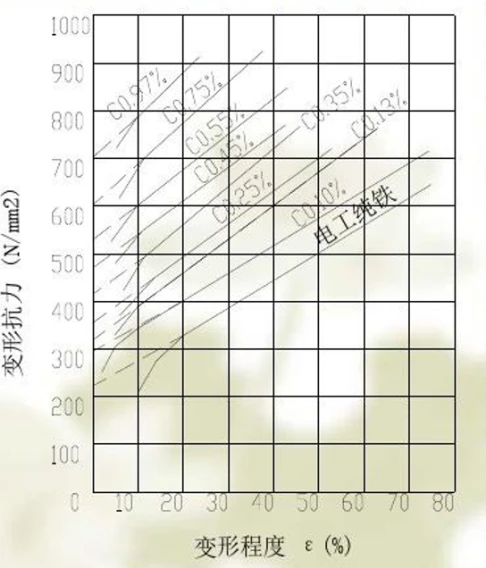
The higher the carbon content of the material, the greater its deformation resistance. Therefore, in the cold working process, intermediate heat treatment procedures need to be appropriately added to eliminate cold working hardening and internal stress. Otherwise, continuing the cold heading process will be difficult.
3. Influence of Part Shape and Die Shape on Cold Heading Force
Due to the friction between the part and the die, the plastic deformation of the blank deformed under pressure between the punch and the die is uneven. During the deformation of the workpiece blank, friction will hinder metal flow, resulting in different metal flow in different parts. Deformation is particularly difficult and slow at corners and edges. Therefore, when the blank is controlled differently within the die, the required cold heading deformation force is also different. Different upsetting forms have different upsetting coefficients K . For open-die upsetting, the coefficient is taken as 1.2-2.7; for closed-die forging (upsetting), the coefficient is 2.4-5; for upsetting with backward extrusion, the coefficient is 4-9.
4. Calculation Method of Cold Heading Deformation Force
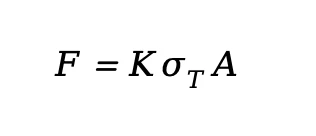
Where:
F— Cold heading deformation force (MPa)
K— Shape coefficient of the upset head; generally 2-2.4 for screws and bolts.
 — Deformation resistance considering cold working hardening.
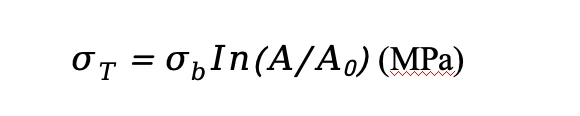 (MPa)
 — Ultimate tensile strength of the metal material (MPa)
A— Maximum projected area of the head after upsetting (mm²)
 — Cross-sectional area of the blank before upsetting (mm²)
➢ Commonly Used Metal Materials for Cold Heading and Material Preparation
Commonly used metal materials are divided into two major categories: ferrous metals and non-ferrous metals.
Requirements for Cold Heading Steel:
Requirements for mechanical properties
Requirements for chemical composition
Requirements for metallographic structure — It is generally considered that grades 1-4 are coarse grains, and 5-8 are fine grains. Coarse-grained materials have greater sensitivity to cold working hardening and poorer plasticity than fine-grained materials. The suitable grain size for cold heading is preferably grades 4,5 and 6.
Requirements for material surface quality — Surface defects and surface decarburization of steel.
Requirements for dimensional accuracy
Requirements for surface lubrication
Modification Process of Cold Heading Materials
Material Heat Treatment — Low-temperature stress-relief annealing, full annealing, spheroidizing annealing (For medium carbon steel with C > 0.25%, to meet the process requirements of cold deformation, spheroidizing annealing is often required.), solution treatment (For cold heading austenitic stainless steels such as 1Cr18Ni9Ti, solution treatment methods must be adopted to achieve steel softening).
Pickling of Materials
Pre-treatment before pickling: After heat treatment of steel, the oxide scale on the surface is relatively thick and cannot be removed solely by pickling. Mechanical descaling (shelling) is usually performed.
Pickling methods: Sulfuric acid pickling, hydrochloric acid pickling, pickling quality.
Lubrication treatment: Tallow-lime lubrication, phosphating-soaping (saponification) treatment.
Modification of materials.
2026 October 3rd Week WBM Product Recommendation
WBM produces taper roller dies with high efficiency and automation. Rollers are formed on a single automatic cold heading press and are fed, cut, and punched into the die for five steps.
We can produce different types and sizes taper roller dies with quality assurance,include:Combination Punch,Outside Sleeve,Blade,Combination Punch,Feed Cylinder,Combination Dies,Double Layer Sleeve,Insert.