I Factors affecting the surface roughness of grinding machines and their improvement measures
1. Factors related to grinding wheels
Mainly the particle size, hardness, and dressing of the grinding wheel.
The finer the grain size of the grinding wheel, the more abrasive particles per unit area, the finer the scratches on the grinding surface, and the smaller the surface roughness value. But if the particle size is too fine, the grinding wheel is prone to clogging, which increases the surface roughness value, and also easily produces ripples and causes burns.
The hardness of a grinding wheel refers to the ease with which abrasive particles detach from the wheel after being subjected to grinding force. The grinding wheel is too hard, and the abrasive particles cannot fall off after wear, causing strong friction and compression on the surface of the workpiece, increasing plastic deformation, increasing surface roughness values, and also easily causing burns; The grinding wheel is too soft, and the abrasive particles are prone to detachment, which weakens the grinding effect and increases the surface roughness value. Therefore, it is necessary to choose the appropriate hardness of the grinding wheel.
The quality of grinding wheel dressing is closely related to the dressing tools used and the longitudinal feed rate of the dressing wheel. The dressing of a grinding wheel is to use diamond to remove the passivated abrasive particles on the outer layer of the grinding wheel, making the cutting edge of the abrasive particles sharp and reducing the surface roughness value of the grinding surface. In addition, the smaller the longitudinal feed rate of the grinding wheel, the more cutting micro edges on the repaired grinding wheel, and the better the contour, thus obtaining a smaller surface roughness value.
2. Factors related to workpiece material
Including the hardness, plasticity, thermal conductivity, etc. of the material.
The hardness, plasticity, and thermal conductivity of the workpiece material have a significant impact on surface roughness. Soft materials such as aluminum and copper alloys are prone to clogging the grinding wheel, making it difficult to grind. Heat resistant alloys with high plasticity and poor thermal conductivity are prone to early collapse of sand particles, leading to an increase in surface roughness during grinding.
3. Factors related to processing conditions
Including grinding parameters, cooling conditions, and the accuracy and vibration resistance of the process system.
Grinding parameters include wheel speed, workpiece speed, grinding depth, and longitudinal feed rate. By increasing the speed of the grinding wheel, it is possible that the propagation speed of plastic deformation in the surface metal cannot keep up with the grinding speed, and the material cannot deform in time, resulting in a decrease in the surface roughness value of the grinding surface. As the workpiece speed increases, plastic deformation increases and the surface roughness value increases. The greater the grinding depth and longitudinal feed rate, the greater the plastic deformation, thereby increasing the surface roughness value. When grinding with a grinding wheel, the temperature is high and the heat plays a dominant role, so the role of cutting fluid is very important. The use of cutting fluid can lower the temperature in the grinding zone, reduce burns, flush away falling sand particles and chips, and avoid scratching the workpiece, thereby reducing the surface roughness value. But it is necessary to choose appropriate cooling methods and cutting fluids.
In addition, for external cylindrical grinders, internal cylindrical grinders, and surface grinders, the spindle accuracy of the machine tool grinding wheel, the accuracy and smoothness of the feed system, the stiffness and vibration resistance of the entire machine tool are closely related to the surface roughness.
II The dressing technique of grinding wheel
Sharpening is a process of sharpening the abrasive grains of a superhard grinding wheel. In this process, it is necessary to remove the binder between the abrasive grains and blunt grinding wheel abrasive grains, so that the abrasive grains with strong grinding performance protrude from the binder and form sharp cutting edges. Sharpening must also remove small materials from the air holes on the surface of the grinding wheel to prevent an increase in grinding force acting on the wheel. An increase in grinding force on the wheel can cause vibration and burn the surface of the parts.
Without proper sharpening, even the best grinding wheel cannot achieve high quality and dimensional consistency of machined parts. In fact, when you invest in high-quality grinding wheels, it becomes very important to properly condition them in order to achieve high grinding performance.
Plastic surgery can be said to be a part of the preparation work of grinding wheels, which is carried out simultaneously with the sharpening of ordinary grinding wheels. For ultra hard abrasive grinding wheels, the two processes are carried out separately, first shaping the grinding wheel. In the use of superhard abrasive grinding wheels for grinding, shaping is carried out using shaping tools or rollers, and sharpening is often done using a ceramic bonding agent trimming rod. After shaping is completed, the grinding wheel is sharpened.
It is important to ensure that the spindle bearings are at a certain temperature (such as the usual grinding state of the grinding wheel) before the grinding wheel, including shaping and sharpening. This can avoid damaging the geometric shape of the parts and abnormal wear of the grinding wheel and dressing tools. Tools used for trimming must be handled with care, as they are generally made of hard, wear-resistant but brittle diamond material and are highly sensitive to small cracks and breakage caused by slight collisions and forces.
Due to the fact that the diamond shaper itself is a cutting tool, it needs to be kept very sharp. Using a dull dressing tool to trim the surface of the grinding wheel will make it dull. In order to maintain a high-quality and sharp diamond dressing tool, it is necessary to rotate the single point or tapered dressing tool 1/8 turn every certain time. The number of rotations can be determined based on the adjustment situation, and according to experience, it should be rotated at least once a day. For chisel heads and shaping tools, they generally need to be rotated 180 ° before they become dull.
Most cylindrical grinders place the parts and grinding wheel on a horizontal line. The highest point of the outer circle of the part and the highest point of the outer circle of the grinding wheel are called the contact point of the part/grinding wheel. Diamond dressing tools should be used to dress the grinding wheel as close as possible to the contact point of the part/grinding wheel. For grinding wheels used in internal grinding machines, it is more important to use a diamond dressing tool close to the highest point of the outer circle of the grinding wheel (i.e. the contact point between the part and the grinding wheel during hole grinding) for dressing.
III Take micro adjustments
There seems to be a temptation to choose a larger removal depth in order to reduce the repair time. This is an extremely erroneous idea. The most suitable removal depth must be selected for dressing the grinding wheel. Choosing a too large removal depth will result in high cutting temperatures, reduce the service life of the dresser, and also cut off useful grinding wheel layers. The ultimate result is to damage both the dresser and the grinding wheel, which is counterproductive. The optimal amount of adjustment is based on the criterion that after several adjustments, the geometric shape of the grinding wheel can be restored while producing a good grinding edge. When using a single point dressing tool, the diameter direction of the grinding wheel should be in contact with the axis at an inclination angle of 10-15 degrees. This will cause the single point trimming tool to produce a sharpening effect during regular rotation. The trimming tool with multi-point contact does not need to be tilted at this angle. Change to using the entire end face of the dressing tool in contact with the surface of the grinding wheel.
The lateral movement speed is the speed at which the dressing tool passes through the surface of the grinding wheel during dressing. It plays a crucial role in the surface roughness and metal cutting rate required for machining parts. If the lateral movement speed is too slow, it will block the grinding wheel, damage the surface roughness and metal cutting rate of the parts. Too slow lateral movement speed can also cause vibration of the grinding wheel and burn the surface of the parts. A uniform and fast lateral movement speed can refine the surface of the grinding wheel, improve its grinding performance, increase grinding efficiency, and reduce the surface roughness of the parts.
Maintain cooling
Proper use of coolant can accelerate repair speed and improve repair efficiency. Based on experience, selecting a 3/8-inch diameter coolant can remove a large amount of heat from the conditioner and extend its service life. When the diamond dressing tool passes through the grinding wheel, install a coolant nozzle to cover the entire surface of the grinding wheel or continuously add coolant to the diamond dressing tool. After the dressing tool comes into contact with the grinding wheel to start dressing, it is never allowed to remove the dressing tool from the coolant. Otherwise, the diamond dressing tool may crack or rupture under extreme temperature changes of cold and hot.
Using filters for high-precision filtration of coolant can avoid multiple cycles of dirt or chips in the coolant. Contaminated coolant can cause the grinding wheel to wear out quickly, increasing the number of times the grinding wheel needs to be repaired. Dry dressing should only be applied to the grinding wheel during dry grinding (in which case the cooling of the diamond dressing tool can be interrupted). Before starting work every day, turn off the coolant and let the sanding wheel idle for a few minutes. This can prevent the grinding wheel from breaking.
Vibration is the enemy of repair
In grinding wheel dressing, it is crucial to effectively reduce vibration, avoid leaving dressing marks, collisions, and damaging dressing tools on the surface of the grinding wheel. This means that the balance of the grinding wheel must also be maintained, which is determined by the structural characteristics of the grinding wheel itself. Uneven density and the overall geometric shape of the grinding wheel can affect the inherent balance of a grinding wheel. Therefore, choosing a high-quality grinding wheel is also very important. If it is a high-quality grinding wheel, proper installation can maintain good balance of the wheel. According to the manufacturer's factory instructions, the grinding wheel is marked with an upward arrow, indicating the light end orientation of the wheel after rough balancing. Then the user can adjust the grinding wheel according to the arrow instructions to achieve dynamic balance. Adding coolant evenly can sometimes help maintain the balance of the grinding wheel.
In order to further avoid vibration, it is necessary to ensure that the trimming tool is firmly clamped on the clamp and maintain a minimum hanging amount to ensure that the trimming tool has sufficient rigidity. If the diamond tool is not firmly clamped, it will cause vibration, produce noise, create ripples on the surface of the part, scratch the surface of the part, and damage the repair tool.
A superhard abrasive wheel must undergo shaping and sharpening before starting grinding. Following the experience introduced in this article will help your grinding wheel produce the best grinding effect.
IV The influence of grinder accuracy on the machining accuracy of workpieces
The geometric accuracy, stiffness, thermal deformation, motion stability, and vibration resistance of the grinder will directly affect the machining accuracy of the workpiece.
1. Geometric accuracy of grinding machine
It refers to the motion accuracy and mutual position accuracy of each component without bearing load. It is impossible to manufacture machine tools with absolute precision, as there will inevitably be some degree of error. This error will be reflected to varying degrees on the workpiece during processing, affecting its machining accuracy. Generally, there are radial runout and axial displacement of the spindle, straightness of movement of moving parts such as the worktable, mutual position errors and transmission errors of working parts, etc.
The radial runout and axial displacement of the grinding wheel spindle, as well as the motion error of the grinder head frame, not only affect the surface roughness of the workpiece after grinding, but also cause roundness and end face runout of the workpiece, resulting in uneven sparks during the grinding process. When the worktable moves on a non perpendicular vertical plane, it affects the straightness of the workpiece's generatrix on both the internal and external cylindrical grinders, resulting in large flatness errors on the workpiece during surface grinding. The centerline of the grinding wheel spindle axis of the external cylindrical grinder and the centerline of the grinding wheel axis axis of the internal cylindrical grinder are not at the same height as the centerline of the workpiece head frame axis. When grinding the inner and outer cones, the workpiece generatrix is hyperbolic. The centerline of the grinding wheel spindle axis is not parallel to the direction of movement of the worktable, which affects the flatness of the workpiece end face after grinding. The transmission error of the grinder has a significant impact on the machining accuracy of thread grinding and gear grinding.
2. Stiffness of grinding machine
It refers to the ability of a grinder's components to resist deformation when subjected to external forces (grinding force). That is to say, under the same grinding force, the smaller the deformation of the component, the greater the stiffness. On the contrary, if the deformation of a component is large, it indicates that the stiffness of the component is small. The size of these deformations destroys the static original geometric accuracy of the grinder and will cause machining errors in the workpiece. So machine tools with good rigidity have high machining accuracy for workpieces.
3. Thermal deformation
The distribution of heat sources inside the grinder is uneven, and the amount of heat generated by each part during movement is also different. The impact of external heat sources on various parts of the machine tool is also different, and the thermal expansion coefficients of components are also different due to different materials, resulting in different micro deformations in various parts of the machine tool, which reduces the original geometric accuracy of the machine tool and affects the machining accuracy of the workpiece. So it is best to install precision grinders in a constant temperature chamber to prevent temperature changes from affecting the accuracy of the machine tool and workpiece.
4. Crawling of grinding machine moving parts
The phenomenon of uneven movement of moving parts such as grinding machine worktable and grinding wheel frame during micro periodic feed or low-speed continuous movement is commonly known as crawling. When this phenomenon occurs in the grinding machine, it causes uneven feed during the grinding process, which affects the surface roughness of the workpiece during grinding.
5. Vibration of Grinding Machine
The grinder generates vibration during the grinding process, causing periodic changes in the relative position between the grinding wheel and the workpiece, resulting in vibration patterns on the surface of the workpiece, which seriously affects the machining quality and accuracy.
To improve the accuracy of the ground workpiece, in addition to striving to eliminate the influence of the above factors, it is also necessary to pay attention to the reasonable selection of positioning benchmarks, clamping methods, selection and correct repair of grinding wheels, and reasonable selection of grinding quantities and process methods during the workpiece processing.
2026 April 2nd Week WBM Product Recommendation
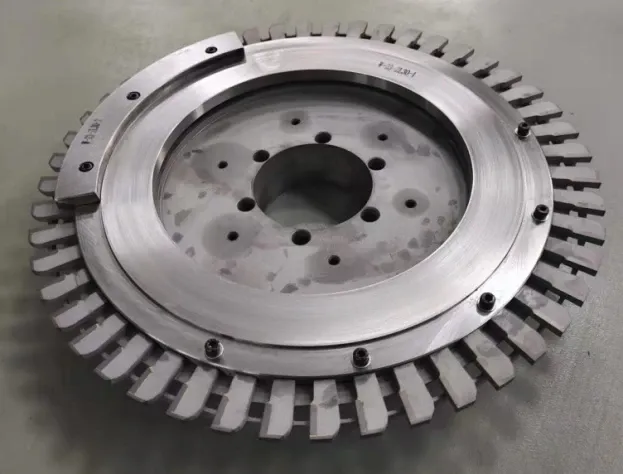
Modler End Face Grinder Tools
Weichuang now have the ability to supply full set tooling for Modler taper roller grinding line. Our tooling are well fitted in customer modler centerless grinder and modler end face grinder. And help customer produce high precision rollers with low cost.