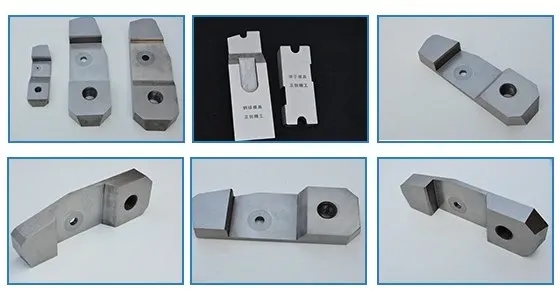
For a long time, the company has adopted a single station horizontal cold heading process for its tapered roller blanks, which is characterized by high efficiency and automation. However, due to the fact that the metal only undergoes one upsetting and forming process, the material undergoes rapid deformation, resulting in low dies life. This requires full consideration of the dies life when designing the dies.
The roller is formed by upsetting on a single click automatic upsetting machine, which requires five steps: feeding, cutting, entering the die, forming, and exiting the die. Among the tools used for the entire set of cold heading tapered rollers, the die is the main one that affects the stamping quality. The die is a stationary part in the process of stamping the blank into a shape. During the stamping process, it has to withstand a lot of pressure and is prone to wear, sinking, or cracking. In order to improve the service life of the dies, reduce tool costs, and enhance economic efficiency, the structure of the tapered roller concave dies cavity adopts a combination structure.
The six body modular structure that companies researched and promoted in the 1980s and 1990s mainly consisted of six parts (Figure 1). This combination model cavity structure has the following characteristics: (1) The transition sleeve 2 and the working sleeve 3 are matched with a reverse taper, and the outer sleeve 1 and the transition sleeve 2 are also matched with a reverse taper, resulting in a large interference fit and generating a large pre stress. This pre stress can offset some of the impact force during stamping, thereby improving the load-bearing capacity of the dies and preventing the working sleeve from cracking. (2) Considering the material deformation and excessive friction at the connection between the chamfer and the conical surface of the concave model cavity, which can easily lead to stress concentration, the parting surface is selected at the connection between the chamfer and the conical surface. The structure of this concave dies cavity basically ensures the lifespan of the dies.
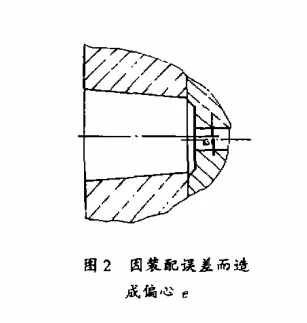
Figure 2: Eccentricity caused by assembly errors
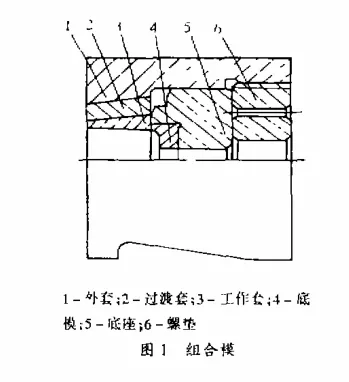
1-Coat; 2- Over fitting; 3- Work set; 4- Bottom dies; 5- Base; 6-Screw pad
Figure 1 Combination Model
With the increasing demand for roller stamping quality, a problem has become more prominent in production, that is, when assembling the six body combination dies, due to the incomplete structure of the original dies, the assembly guidance between the base 5 and the outer sleeve 1 is not very good, resulting in assembly errors when assembling the working sleeve 3 and the bottom dies 4. After tightening the screw pad 6, it often causes the center of the bottom dies to deviate from the center of the working sleeve (Figure 2). The shape of the roller after stamping is characterized by small head chamfer deviation and large displacement. Measuring the displacement of the small head often exceeds 250 μ m, which often leads to the scrapping of rollers with high product requirements. After practical summary and analysis, the six body composite dies structure has been improved. The improved combination dies is shown in Figure 3, which extends the transition sleeve 2 along the conical surface, and the working sleeve 3 and the bottom dies 4 form a working sleeve for secondary assembly inside the transition sleeve. Then, the outer sleeve 1 and transition sleeve 2 are assembled for the second time using a press machine, and the screw pads are tightened to ensure assembly quality.

Coat; 2- Over fitting; 3- Work on the upper dies; 4- Lower dies of the working set; 5-Intermediate pad; 6-Screw pad
Figure 3 Improved Composite Model
Practice has proven that the improved combination dies eliminates the eccentricity between the working sleeve and the bottom dies caused by assembly, prevents small head chamfer deviation, ensures the quality of the rollers, improves labor productivity, and achieves good economic benefits.
2024 September 1st Week WBM Product Recommendation:
Cutter:
WBM produces taper roller dies with high efficiency and automation. Rollers are formed on a single automatic cold heading press and are fed, cut, and punched into the die for five steps.
We can produce different types and sizes taper roller dies with quality assurance,include:Combination Punch,Outside Sleeve,Blade,Combination Punch,Feed Cylinder,Combination Dies,Double Layer Sleeve,Insert.