https://www.bearingroller.com/rolling-elements/taper-roller/
I. Analysis and selection of working conditions of tapered roller bearings
(1) Analysis of working conditions
Bearings are widely used in various mechanical equipments and vehicles such as diesel engines, tractors, machine tools, automobiles and trains. They consist of four parts: the inner ring, the outer ring, the rolling elements and the cage. The inner ring is tightly mounted on the spindle and rotates with the shaft. The outer ring is mounted in the bearing housing and is stationary. During the rotation of the shaft, the inner ring and the rolling element rotate and roll, serve under high-speed motion, and withstand cyclic high-pressure alternating loads and stresses of point or line contact. The role is therefore easy to cause local stress concentration. The rolling body and the inner and outer rings are both rolling and sliding, so rolling friction and sliding friction are generated. Therefore, the above process can be analyzed. The damage form of the rolling bearing is contact fatigue damage and wear, and the rolling element and the inner and outer rings should be required. High fatigue resistance and wear resistance, good dimensional stability, to ensure high bearing life.
(II) Failure analysis of tapered roller bearings
In general, the main failure modes of rolling bearings are fatigue spalling under alternating stress and loss of bearing accuracy due to frictional wear. In addition, there are cracks, indentations, rust and other causes of abnormal damage to the bearing.
(1) contact fatigue failure; (2) wear failure; (3) fracture failure; (4) plastic deformation failure; (5) clearance change failure.
(III) Performance requirements Tapered roller bearings shall have the following properties after heat treatment of materials:
(1) high contact fatigue strength;
(2) high wear resistance;
(3) high elastic limit;
(4) suitable hardness;
(5) a certain impact toughness;
(6) Good dimensional stability.
Second, the choice of material for tapered roller bearings
(1) Material primary selection
At present, the most widely used in domestic use is high carbon chromium bearing steel, its composition is characterized by: high carbon, bearing steel W (C) is generally controlled in the range of 0.95% ~ 1.05%, to ensure the hardness after quenching The maximum value is obtained simultaneously with a certain amount of carbide to improve wear resistance. Cr is the basic alloying element, and the W(Cr) of the bearing steel is generally controlled to be 1.65% or less. On the one hand, Cr improves the hardenability and makes the microstructure and hardness after quenching uniform; on the other hand, Cr dissolves in the cementite to form a relatively stable Cr-containing cementite, and the alloy cementite dissolves during quenching and heating. It is slow and evenly distributed on the substrate with fine particles, which is beneficial to improve wear resistance.
(2) Final selection of materials
GCr15 is a typical steel grade in chrome bearing steel. It is used in a large amount, accounting for about 90% of chrome bearing steel. The composition of chrome bearing steel used abroad is also roughly similar. GCr15 steel contains a small amount of alloying elements, good overall performance, high and uniform hardness after quenching and tempering, good wear resistance and high contact fatigue strength. The hot-worked steel model has good machinability after spheroidizing annealing. In summary, tapered roller bearings can be selected from GCr15 steel.
Third, the tapered roller bearing heat treatment process design
The parts that make up the rolling bearing are the outer ring, the inner ring, the rolling elements and the cage. The processing and methods are different for different parts. For the same part, if the structure and tolerance level are different, the processing and methods are different. The most widely used in bearing steel is GCrl5. Heat treatment process of tapered roller bearings with GCr15 as steel. Here we mainly discuss the heat treatment of the ferrule.
(1) Processing route of the ferrule
The ferrule heat treatment process includes annealing, quenching, tempering, etc. Each process has different effects on the performance of the ferrule material, and the position in the entire process flow of the ferrule is also different. The specific process route is: pipe material or bar material - forging - spheroidizing annealing - car processing forming - soft grinding (mainly for the channel) - quenching - tempering - rough grinding - fine grinding - finished product.
(2) Heat treatment process of the ferrule
1. preliminary heat treatment
After the pre-heat treatment of the bearing steel, a uniform fine spherical pearlite structure should be obtained, without flakes and reticulated carbides. The heat treatment of the structure has high contact fatigue strength, wear resistance and toughness, and the tendency of overheat deformation is reduced, so the bearing steel is subjected to spheroidizing annealing. The purpose of spheroidizing annealing is to improve the microstructure of the blank, reduce the hardness of the material, facilitate the cutting process, and prepare the spheroidal carbide for the subsequent heat treatment process to form a uniform spherical carbide. Improving the machinability of steel can increase the hardenability of steel. The annealing temperature is based on the critical point of the steel, and the spheroidizing annealing temperature of GCr15 is 780-810 °C.
2. Final heat treatment
(1) quenching
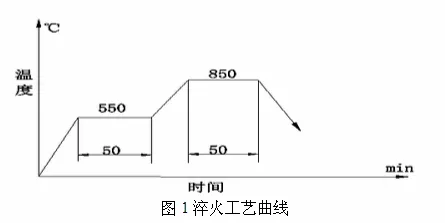
The quenching of steel is to heat the steel to a temperature above the critical temperature Ac3 (hypoeutectoid steel) or Ac1 (hyper-eutectoid steel), keep it for a period of time, make all or part of austenite, and then exceed the critical cooling rate. A heat treatment process in which martensite (or bainite) transformation is performed at a cold rate and rapidly cooled to below Ms (or isothermal near Ms). In general, the quenching + low temperature tempering of the bearing steel is the final heat treatment, the heating temperature of the GCr15 quenching is 830-860 ° C, the cooling medium is the mechanical oil of No. 10 or No. 20, and the temperature of the cooling medium is 30-80 ° C.
Quenching process of GCr15 steel: The sample is heated to 840 ° C for 20 min, oil cooling, quenching process curve as shown.