Abstract: Analyze the factors that affect the service life of roller cold heading molds, improve their service life, and save mold costs.
Keywords: Roller cold heading mold; Lifespan; Improve; influence factor
1. Introduction
The method of cold forging is used for large-scale processing of rollers. Cold forging is a key process in roller processing, and the quality of the cold forging mold directly affects the forming quality of the rollers. The lifespan of cold heading molds is not only related to their material properties, manufacturing technology, heat treatment technology, and other factors, but also to the structural design of the molds.
With the increasingly fierce competition in the bearing industry and the increasing personalized requirements of users, not only are the quality requirements for rollers getting higher, but also the corresponding requirements for the cost-effectiveness of rollers have been put forward. This requires the roller cold forging die to not only meet its functional requirements, but also have a high service life and good economic performance. The lifespan of cold heading molds not only affects the processing cost of rollers, but also affects production progress and product delivery time.
2. Analysis of current problems
Previously, due to factors such as cold heading mold material, mold structure design, and mold manufacturing process, the quality of cold heading molds was unstable, their service life was low, and the cost of roller manufacturing was high.
The mold material has the problem of low performance in use. The plastic deformation of the mold material is large, and the thermal expansion is fast, resulting in rapid changes in the size of the roller burrs. The cutting length needs to be adjusted frequently, which leads to significant fluctuations in the quality of the roller cold forging blank and a high scrap rate in the cold forging process.
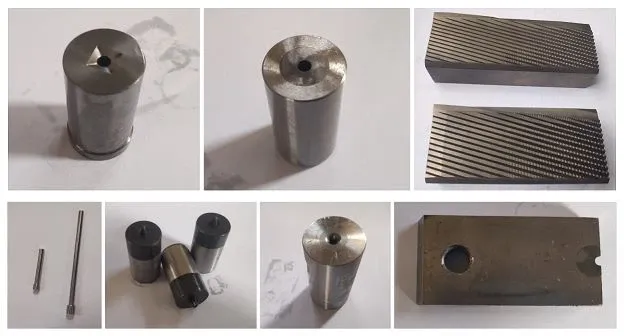
There is an issue of unreasonable design in the structure of cold heading molds. As the main fixtures in the cold heading process, the chamfer and cavity structure design of the punch are unreasonable, resulting in uneven chamfer size, excessively large or small cavity diameter, falling blocks in the cavity of the punch, and insufficient punching and other quality problems. The unreasonable design of the concave mold structure has caused quality problems such as core running and jamming of the working sleeve. There is a problem of outdated process in mold manufacturing technology. The punch die adopts a turning process and does not use the currently popular extrusion process.
Based on the analysis and discussion of the factors that affect the service life of cold heading molds mentioned above, it is decided to study and improve the design and manufacturing technology of cold heading molds. By studying the failure forms of cold heading punches and dies, the causes of failure and solutions are identified.
3. Main measures to improve the service life of roller cold heading molds
When designing roller cold forging molds, it is necessary to meet the requirements and service life of the product, as well as to meet low costs. Through a large amount of experiments, it was found that the main forms of failure of cold heading molds are: poor rigidity of the mold material and rapid size expansion; Core running of concave mold working sleeve; The concave mold work sleeve is jammed; Punch the head and drop the hole; Undercharge, etc. By searching for various failure reasons and addressing the problems in the mold structure, this study analyzes the main factors affecting the service life of cold heading molds. Based on the development trend of mold manufacturing technology at home and abroad, and combined with the current situation of cold heading mold usage, the design and manufacturing technology of cold heading molds are improved from the aspects of materials, structure, and manufacturing technology. In terms of mold materials, mold alloying technology is mainly used; In terms of mold structure, improve the design method of mold structure; In terms of mold manufacturing technology, the main focus is on changing the manufacturing process of punches from turning to extrusion.
The alloying technology of roller molds has been studied and applied by many roller production enterprises at home and abroad in recent years due to its significant effects on improving the mold life and the quality of roller blank forming, as well as its good performance price ratio. Through extensive investigation and research on mold materials, life tests were conducted on hard alloy materials, and experiments were conducted to introduce a hard alloy material with high hardness, strength, toughness, good manufacturing process performance, and high cost-effectiveness.
Roller mold alloying refers to a method of using hard alloy to completely or partially replace mold steel as mold material. It improves the service life of the mold by selecting suitable hard alloy to replace mold steel in manufacturing. Hard alloy and ordinary compared to using mold steel, it has the following advantages: excellent wear resistance; The coefficient of thermal expansion is smaller than that of mold steel, and the temperature increases during operation, resulting in smaller dimensional errors of the mold compared to steel molds; The elastic modulus is much higher than that of steel, and when subjected to pressure, the flexural deformation is much smaller; Low friction coefficient, good fluidity of roller material in the mold; The affinity to the processed roller material is small, and the surface of the mold is not easily scratched or roughened. The key to the alloying technology of roller molds depends on the selection of hard alloy materials with good process performance. The reasonable selection and formulation of process parameters for mechanical processing, heat treatment, and surface treatment are all important factors for the smooth implementation of this technology.
The key to improving the design of mold structure is to reasonably optimize and select factors such as the chamfer coordinates, chamfer radius, hole diameter, hole depth, mold structure, and mold geometry of the blank. Improving the design of mold structure mainly includes: improving the design of punch chamfer, hole diameter, hole depth, and hole geometry; Improve and design the current integrated concave mold into a combination concave mold; Further improve the structure of the combined concave mold and optimize the design of the concave mold angle, base step, and chamfer in a reasonable manner.
The improvement of punch structure mainly involves improving the geometric shape of the punch hole, increasing the angle between the tangent line of the hole bottom arc and the center line of the punch (=20.~30.), which is not only conducive to the flow of materials during cold heading, reducing stress concentration, but also has a draft angle, making it easy to withdraw the mold, thereby solving the problems of easy hole dropping and under punching of the punch, and improving the service life of the punch; At the same time, appropriately increasing the chamfer radius, standardizing the design of hole diameter and hole height, and improving the quality of finished large end chamfers.
Improve and design the current integrated concave mold into a combination concave mold (mainly short cylindrical and small conical rollers); Reduce the clamping height of the bar material (hmax=3-4, hmin: 1.5-2.5), thereby reducing the force intensity of the concave die working sleeve and the friction between the bar material and the working sleeve, reducing the problem of clamping damage on the working sleeve, and improving the service life of the concave die; Optimize the design of the concave mold base steps and chamfers, reduce underpunching of the blank small end, and improve the quality of finished small end chamfers.
After tracking and analyzing the issue of the core running of the concave mold working sleeve, it was found that the core running of the concave mold working sleeve was caused by the repeated use of the concave mold outer sleeve and size expansion in order to save mold costs, while the new working sleeve had the same size, resulting in a small interference between the outer sleeve and the working sleeve after assembly. Therefore, the repeated use of the concave mold jacket is limited (no more than 4 times), avoiding the core running problem caused by the small interference amount of the concave mold jacket during repeated use.
In terms of punch manufacturing technology, the internationally popular extrusion process is adopted to replace turning technology. The material has a dense organization and greatly improves its lifespan. Extrusion technology is a rapidly developing new process that replaces turning with extrusion. It does not cut off the fiber flow direction to make the material structure dense, with continuous fiber direction, greatly improved stress strength, good dimensional consistency and geometric accuracy, high production efficiency, and can improve the utilization rate of punch manufacturing materials. It has advantages in technology and economy.
4. Application effect
By improving the structural design of cold heading molds, researching the application of hard alloy materials and improving mold manufacturing processes, the forming quality of roller cold heading blanks has been significantly improved. The size of roller burrs is more stable, the geometric shape accuracy and surface quality have also been improved. The pass rate of cold heading process blanks has increased from 97% to over 99%, and the service life of cold heading molds has been increased by 2-3 times. At the same time, the auxiliary work time for mold replacement has been reduced, Greatly improved production efficiency.
By studying the failure forms of cold heading molds, further improving the mold structure, materials, and manufacturing processes, the service life of the molds has been improved, the consumption costs of the molds have been reduced, production costs have been lowered, and good economic benefits have been achieved, providing strong technical support for the development of enterprises.
2023 December 2nd Week WBM Product Recommendation:
Rolling Dies:
As one of the professional tool manufacturer, provides rolling die with high hardness,fast delivery and good service.
https://www.bearingroller.com/tools/rolling-dies.html