2.1.4 Determination of forging frequency
In cold heading, products usually need to go through two or more upsetting processes before they can be formed. The reasonable determination of forging frequency will fully utilize the allowable deformation degree of the metal, improve the service life of the mold, and ensure the quality of the product. Determine the number of upsetting times, considering the following factors:
a. Forging ratio
If the ratio of the length to the diameter of the deformed part of the billet is too large, a longitudinal bending phenomenon will occur in one forging, and after flattening, a sandwich will appear, as shown in Figure 36-9. To avoid these defects during forging, it is necessary to increase the number of forging cycles. Firstly, the billet is pre upsetting into a conical shape, and then precision upsetting is carried out until it reaches the desired shape.
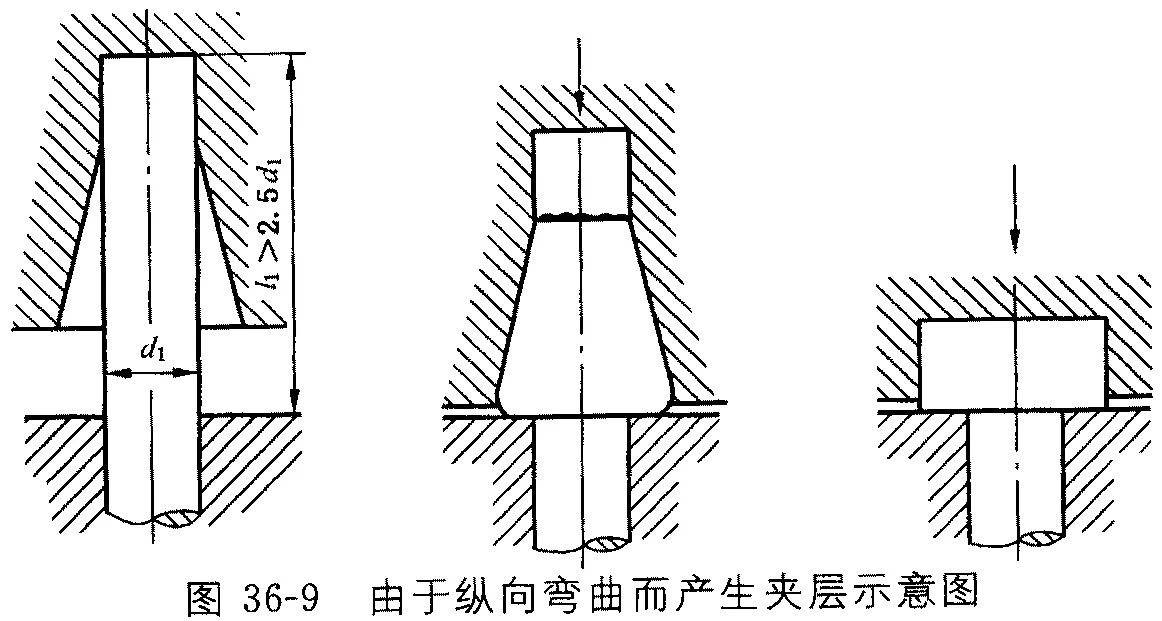
Figure 36-9 Schematic diagram of interlayer caused by longitudinal bending
b. Consider the ratio of the diameter D of the workpiece head to the height H.
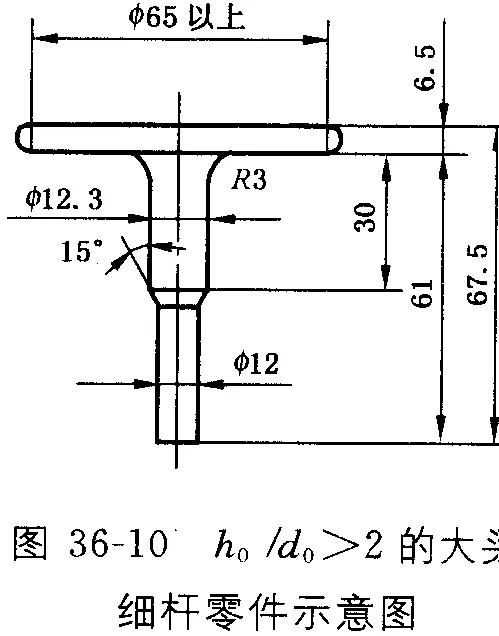
As shown in Figure 36-10, it is a large diameter thin flat head thin rod part with a large head diameter and a small height. The required blank h0/d0 for the large head thin rod part is 2 or more. If a single forging is used, cracks will occur at the edge of the head. Similar workpieces can only be formed gradually by increasing the number of upsetting forging cycles.
c. Consider the surface roughness requirements of the workpiece and the complexity of its external geometric shape
For machine screws with shapes such as semi-circular heads, cylindrical heads, etc., although the ho/do value of the required blank for the head is generally less than 2.5, in order to fill the head during deformation and meet the standard requirements, two upsetting strikes are generally used. Pre upsetting conical head creates favorable metal flow conditions for precision upsetting head forming. For example, using a wire with a large diameter and small deformation to forge nuts, with a wire diameter of 0.9s (s is the size of the opposite side of the hexagonal nut), the deformation degree of the general product is about 25%. However, due to the complex shape of the hexagonal nut, there are many deformation methods in forging, including cold heading, composite extrusion, and punching. In order to facilitate the flow of metal during deformation, 3-4 forging strikes are selected for forming.
It is worth emphasizing that not all products with complex shapes can be solved by increasing the number of upsetting times. Often, some products have an increase in the number of upsetting times and are easily formed in the first and second upsetting, but due to cold work hardening, it is difficult to carry out the product in subsequent upsetting. Manifested as cracking or damage to the mold during forging of the workpiece. The key to solving such problems lies in reducing deformation, increasing the plasticity of steel, and adopting more effective lubrication. Large diameter wire and small deformation process are selected for bolts and screws in the cold heading process. Generally, the diameter of the wire is close to the diameter D of the screw thread, and one or two rod reductions are used to achieve the size of the screw blank. For medium carbon steel and alloy steel, spheroidization annealing is used in material modification to improve the cold heading plasticity of the steel, and phosphating and saponification treatments are used to ensure surface lubrication of the steel and minimize friction during deformation. In addition, adding strength and toughness to the mold allows it to withstand complex deformations with rigidity, as well as sufficient toughness and wear resistance.
2026 July 1st Week WBM Product Recommendation
High Chrome Steel Balls:
G5,G10,G16 Our Chrome ball usually produce according to GBT 308.1-2013 and ISO 3290-1:2014 standards. Hardness will be customized base on your requirement.
https://www.bearingroller.com/rolling-elements/steel-ball/high-chrome-steel-balls.html