https://ask.bearing.cn/new/index.php?m=index&a=view&tp=zczz&id=34995
Most heat-treated parts require grinding, which is the final machining process in mechanical processing. Once heat-treated parts are ground, grinding cracks and burns may occur.
1. What is grinding burn?
Grinding burn is commonly known as grinding burn, which occurs due to the use of a grinding wheel with blocked holes or excessive grinding. In addition, when cutting quenched parts with a grinding wheel, burns often occur on the cutting surface. Once a grinding burn occurs, the polished surface will show tempering colors such as blue or yellow, which can also be seen with the naked eye.
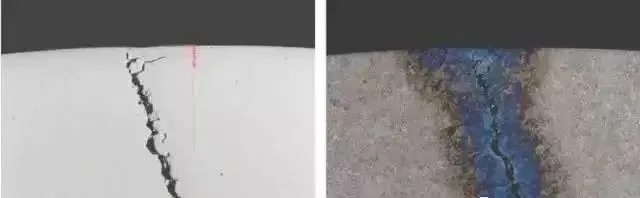
When there is no visible tempering color, acid corrosion can be used. If there are burns after acid corrosion, dark gray or yellow will appear, which makes it easy to detect grinding burns. In industrial standards, it is recommended to use the following acids for corrosion testing of quenched specimens to inspect the cut surface:
The first type of acid solution 5% nitric acid+95% water:
The second type of acid solution 50% hydrochloric acid and 50% water.
The processing procedure is to wash the sample with warm water, corrode the test surface of the sample with the first type of acid solution until the test surface turns black (30-60 seconds), then wash it with warm water, and after 3 seconds of corrosion with the second type of acid solution, wash it with warm water and dry it with air for inspection. On the corroded surface, if there are bright spots (martensitic structure) or dark spots (martensite, martensite structure) mixed, it indicates that the grinding hardness and structure have changed. Organizational change refers to the excessive tempering caused by grinding heat, which transforms the martensite of quenched parts into martensite or martensite; Or locally quenched to become martensite.
To prevent grinding burns, it is necessary to strictly repair the sanding wheel and use a reasonable grinding amount. Do not grind in large quantities due to the addition of grinding fluid, as the grinding fluid cannot enter the grinding surface and can only cool from around the workpiece. It only cools down the parts that have risen in temperature due to grinding heat. It is said that grinding heat can raise the temperature of the grinding surface to over 1300 ℃. Therefore, attention must be paid.
What is the reason for the occurrence of Tang cutting cracks?
Grinding cracks are a phenomenon that occurs during the grinding of parts that have not been tempered after quenching, or parts that contain a lot of residual austenite. These cracks do not occur during grinding, but occur after grinding. Grinding cracks have a unique shape that is different from quenching cracks, so they can be immediately distinguished.
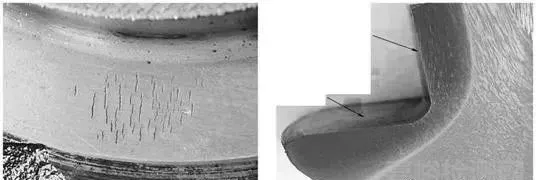
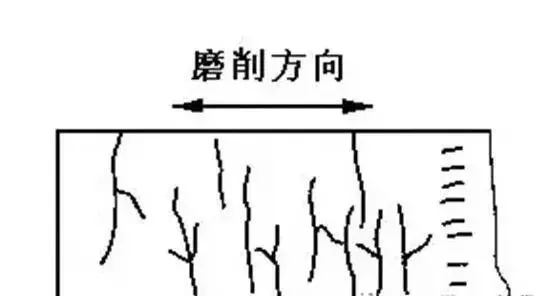
Slight grinding cracks appear as parallel lines at right angles to the grinding direction, while particularly severe grinding cracks appear as turtle shells. The depth is about 0.1-0.2mm, which looks a bit like cracking If etched with acid solution, cracks will be clearly visible.
Direction of grinding
How do grinding cracks occur? The reasons generally include the following aspects:

After quenching, the steel becomes martensitic structure, so it is in an expanded state. If this quenched steel is heated, the first shrinkage occurs at around 100 ℃, and the second shrinkage occurs when it is further heated to around 300 ℃.
In addition, after grinding, the temperature in the grinding zone of the steel increases. What is its temperature exactly? There are various opinions on this, some believe it is 800 ℃; Some people believe it is 1600 ℃. The author of this book learned through experiments that the temperature in the grinding zone is about 600 ℃
Therefore, if quenched steel parts are ground, only the temperature of the grinding surface increases, and the first shrinkage occurs when it reaches 100 ℃. This contraction only occurs on the surface layer, and the parent tissue is still in an expanded state. Therefore, the surface undergoes cracking under tensile stress.
This type of crack is called the first type of grinding crack. When the grinding heat is severe, a second shrinkage occurs when the surface temperature reaches 300 ℃, leading to main grinding cracks This type of crack is called For the second type of grinding crack. From this, it can be seen that there are two types of grinding cracks.
To prevent grinding cracking, the parts must be tempered after quenching before grinding. To prevent the first type of grinding crack, tempering must be carried out within the temperature range of 100-200 ℃; To prevent the second type of grinding crack, it is necessary to temper at a temperature of around 300 ℃.
Also, if there is residual austenite present, grinding heat will cause austenite to transform into martensite. If grinding is continued on this martensite. Grinding cracks may also occur.
2026 May 3rd Week WBM Product Recommendation
Rolling Dies:
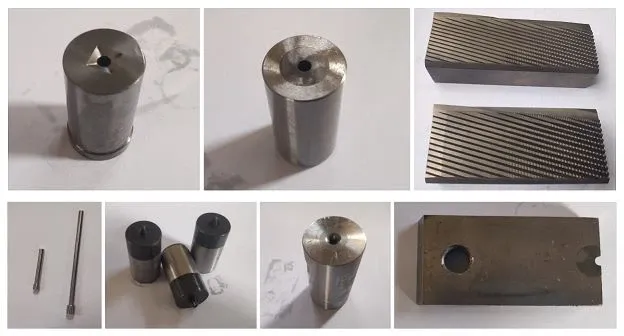
As one of the professional tool manufacturer, provides rolling die with high hardness,fast delivery and good service.
https://www.bearingroller.com/tools/rolling-dies.html