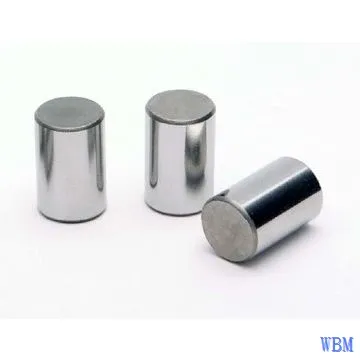
1. Basic concepts
Definition: A taper pin is a cylindrical pin with a taper (usually 1:50 or 1:48) that relies on friction to fit into a tapered hole for fastening and positioning.
Characteristic:
Self locking: The tapered design ensures that the pin becomes tighter and tighter as it is tapped in.
Detachable: can be removed by reverse tapping or pulling tools.
High precision positioning: used in situations where repeated alignment is required (such as gears, couplings).
2. Standards and specifications
International standards:
ISO 2339: Dimensions and tolerances for taper pins (taper 1:50).
DIN 1/DIN 7977: German standard (taper 1:50).
ANSI B5.18: American standard (taper 1:48, commonly used in the machine tool industry).
Dimension annotation:
Label the small end diameter (e.g. ∅ 6 × 60 represents a small end of 6mm and a length of 60mm).
Common diameter range: ∅ 1~∅ 50mm, with a length of up to 300mm.
3. Materials and Processing
|
Materials |
Application Scenarios |
Surface Treatment |
|
Carbon Steel (e.g., 45 Steel) |
General mechanical connections |
Zinc plating, Black oxide coating |
|
Stainless Steel (304/316) |
Corrosion-resistant environments (Chemical, Marine) |
Passivation |
|
Alloy Steel (42CrMo) |
High-stress applications (e.g., Wind power equipment) |
Quenching and tempering (HRC 35-40) |
4. Installation and disassembly
Installation steps:
Drilling and reaming: First drill a straight hole, then use a taper reamer (1:50) to process the tapered hole.
Clean the hole wall: remove burrs and debris.
Knocking in the pin: lightly tap with a copper hammer until the pin is flush with the surface of the workpiece (excessive tapping is prohibited).
Check coordination: The pin should not be loose and the contact area should be ≥ 80%.
Dismantling method:
Use a pin puller or reverse tap from the small end.
Heating the workpiece (assisted disassembly by thermal expansion and contraction).
5. Design Calculation
Cone selection:
1: 50 (ISO/DIN): General Machinery.
1: 48 (ANSI): North American Machine Tool Industry.
Tensile pulling force: depends on the friction coefficient of the taper fit (usually requires experimental verification).
6. Typical application scenarios
Mechanical positioning: The circumferential fixation of gears and shafts.
Safety pin: Shear protection in case of overload (such as transmission system).
Aerospace: Precise alignment of aircraft control linkages (in accordance with NASM series standards).
7. Common Problems and Solutions
Cause and Solution of the Problem
Loose taper hole machining deviation or wear of the pin, re reaming, replace with a larger one pin
Difficulty in disassembly, corrosion or excessive interference, infiltration of oil immersion+heating
Choose higher strength materials (such as alloy steel) for material defects or overload caused by sales fracture.
8. Alternative solutions
Parallel pin+threaded end (such as DIN 7): Additional fastening is required, but it is easy to disassemble.
Elastic cylindrical pin: suitable for vibration environments, but without self-locking properties.
9. Selection suggestions
Light load positioning: Carbon steel galvanized (low cost).
Heavy load/impact: alloy steel quenching+taper 1:50.
Corrosion environment: stainless steel+passivation treatment.
2025 July 3rd Week WBM Product Recommendation:
Interroll Tapered Roller:
Interroll Tapered Roller is a major products of Henan Weichuang Bearing Precision Technology Co.,Ltd.(WBM). If you need more details, please click the website to know more.
https://www.bearingroller.com/rolling-elements/interroll-2tapered-roller.html