Diamond grinding wheel is a circular solid grinding tool with a through hole in the center, made from diamond abrasive as raw material, using metal powder, resin powder, ceramics, and electroplated metal as binders.
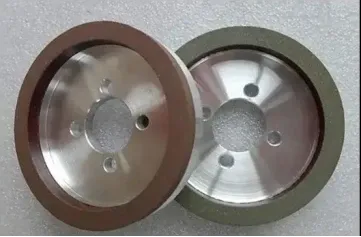
Structure of Diamond Grinding Wheel
Diamond grinding wheels are different in structure from ordinary abrasive grinding wheels, generally consisting of a diamond abrasive layer, a transition layer, and a substrate.
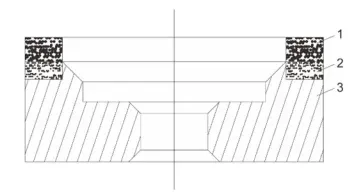
Structure diagram of diamond grinding wheel
Diamond abrasive layer; 2- Transition layer; 3-Matrix
(1) Diamond abrasive layer
The diamond abrasive layer, also known as the working layer, is composed of diamond abrasive, binder, and pores, and is the working part of the grinding wheel that plays a grinding role. Diamond is the main body of grinding behavior; The binder binds diamond abrasive particles into a mold with a certain geometric shape; The porosity characterizes the compactness of the mold and has a direct impact on grinding efficiency and work quality. It can also play a role in heat dissipation and chip holding.
(2) Transition layer
The transition layer, also known as the non diamond layer, does not contain diamond abrasives and is composed of a binder, metal powder, and filler. It is the part that firmly connects the diamond layer to the substrate. To simplify the manufacturing process, it is also possible not to use transition layers.
(3) Matrix
The substrate is used to support the abrasive layer and is firmly clamped onto the grinding machine spindle with a flange during use.
According to the different types of binders, the substrate material for diamond grinding wheels can be steel, aluminum alloy, electric wood, etc. Generally, steel and alloy steel powder are used as substrates for metal bonded grinding wheels; The resin bonded grinding wheel uses aluminum alloy and bakelite as the substrate. The substrate plays a role in supporting the working layer and clamping the grinding tool. The quality of grinding wheel formation and the precision of use are closely related to the substrate. The lighter the matrix, the better, while ensuring strength and stiffness, so aluminum matrix is more common.
Characteristics of Diamond Grinding Wheel
Diamond grinding wheel belongs to the category of superhard abrasive grinding wheel, which has very obvious characteristics and advantages compared to ordinary abrasive grinding wheel:
The hardness of diamond abrasives determines the main characteristics of diamond grinding wheels, which can efficiently grind difficult to machine materials such as hard alloys, glass, ceramics, etc., and the grinding tools have a long service life.
Diamond has high wear resistance, minimal grinding wheel wear, and long service life. During grinding, the size, shape, and morphology of diamond abrasive particles change little, making it suitable for high-precision machining with high production efficiency. Diamond grinding wheels can meet the requirements of both efficient and precision machining.
The sharpened diamond grinding wheel can maintain the micro cutting edge of the abrasive particles for a long time, and its good cutting performance ensures a smaller grinding force during the grinding process, thereby reducing grinding power and saving energy.
Diamond has excellent thermal conductivity, which is conducive to heat dissipation, reduces phenomena such as burns, cracks, and falling blocks on the workpiece, and can improve the machining quality of the workpiece surface.
Classification of diamond grinding wheels
Diamond grinding wheels can be divided into: resin bonded diamond grinding wheels; Ceramic bonded diamond grinding wheel; Diamond grinding wheels with metal and electroplated metal bonding agents.
Diamond grinding wheels can be divided into sintered diamond grinding wheels according to production processes; Electroplated diamond grinding wheel; Brazed diamond grinding wheel.
Diamond grinding wheels can be divided into: diamond grinding wheels for grinding diamonds; Diamond grinding wheels for grinding hard alloys; Diamond grinding wheel for grinding diamond composite discs: centerless diamond grinding wheel for centerless grinding machines; Diamond grinding wheel for grinding ceramic products: Diamond grinding wheel for cutting (also known as diamond cutting blade); Diamond saw blade.
Diamond grinding wheels can be divided into parallel grinding wheels based on their appearance or shape; Cylindrical grinding wheel; Cup shaped grinding wheel; Bowl shaped grinding wheel; Disc shaped grinding wheel; Grinding wheel for edge grinding; Grinding disc, etc.
The use of diamond grinding wheels
Due to the characteristics and advantages of high hardness, high compressive strength, and good wear resistance of diamond abrasives, diamond grinding wheels have become the preferred tool for optical glass, ceramics, gemstones, semiconductor materials, stone and other hard and brittle materials, as well as low iron content metallic and non-metallic hard and brittle materials that are difficult to process with ordinary grinding tools such as hard alloy grinding. The use of diamond grinding wheels not only has high efficiency and accuracy, but also has the characteristics of good roughness, low tool consumption, and long service life. At the same time, it can also improve the working environment. With the continuous development of modern grinding towards high quality, precision, efficiency, and automation, the role of diamond grinding wheels is becoming increasingly evident.
Diamond grinding wheels are widely used in various sectors and fields of industry, such as aerospace, mold manufacturing, semiconductor manufacturing, and optical processing manufacturing. Ceramic materials, optical materials, aviation engine turbine blades, silicon wafer products, etc. are often ground with diamond grinding wheels.
2024 June 4th Week WBM Product Recommendation:
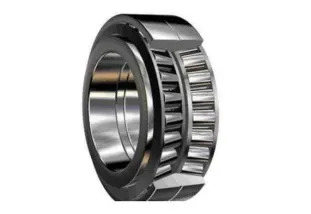
Precision conical drum body for commercial vehicles:
We are proud to announce that Weichuang has successfully developed high-precision tapered rollers with a production capacity of 10 million pieces per month (diameter> 13mm). In addition to this impressive production volume, we still have the remaining capacity of 4 million pieces per month. Our success is attributed to our advanced production equipment, which includes five rolling production lines and seven cold heading machines (three of which are from the United States and four are domestic). Furthermore, our heat treatment capacity is an impressive nine tons per day. At Weichuang, we strive for excellence in our production capabilities and are committed to meeting the needs of our customers.