Abstract
The purpose of the present invention is to provide a long-lived tapered roller bearing comprising rollers with large convex surfaces at a low cost, preferably as a tapered roller bearing for supporting a portion of an automotive transmission rod. The peripheral surface of the roller (3) in the tapered roller bearing is processed into a convex surface by grinding, and then finely processed by drum polishing or barrel polishing to avoid leaving grinding stripes.
Description
Conical roller bearings and machining methods for tapered rollers
technical field
The present invention relates to a tapered roller bearing suitable for supporting, for example, a portion of an automotive transmission rod used in significant misalignment, and a method for processing its tapered rollers.
Background technology
Figure 3 shows an example of a tapered roller bearing used in a typical manual transmission rod section. The bearing has a tapered roller 3 held by a housing 4 and placed between the inner ring 1 and the outer ring 2. The inner ring 2 has a conical rail surface 1a, and a large shaft ring surface 1b is provided on the large diameter side. Outer ring 2 is not an independent component, more precisely, the inner surface of the bearing forms outer ring 2. Due to the structural constraints of the transmission, the bearings used for the part cannot be designed with a thicker cross-sectional height H. However, due to being placed in a heavy load environment, it must have high load capacity, so tapered roller bearings have a wide bearing width and thin and long rollers 3. For example, rollers have a slender shape, where the length of the roller is greater than twice the diameter of the roller.
Generally speaking, if not supplied by the bearing manufacturer, the inner surface of outer ring 2 (gear inner surface) does not have an appropriate crown for the bearing. Meanwhile, due to the significant misalignment and elongated rollers of this type of tapered roller bearing, it is required that this type of tapered roller bearing provide some anti skew capability. Therefore, as clearly shown in Figure 4 (A), a convex surface larger than the usual convex surface is applied to the peripheral surface of roller 3. The crown processed tapered roller 3 is tangent to the rail surfaces 1a and 2a of the inner ring 1 and outer ring 2 in a certain contact area that extends radially from the middle of its longitudinal direction. Due to the deviation of the axis engaged in the inner surface of inner ring 1, the tangential position P may shift.
Meanwhile, during operation, the roller 3 of the tapered roller bearing is driven and rotated by the rail surface 1a of the inner ring 1 or the rail surface 2a of the outer ring 2. The sliding between the large end face 3a of roller 3 and the surface 1b of the large shaft ring of inner ring 1 forms the part used to resist the resistance generated by the rotation of roller 3.
As the tangential position P becomes closer to the small diameter side of inner ring 1, the distance between the large shaft surface 1b and the tangential position P that generates resistance becomes longer. Therefore, as shown in Figure 4 (B), tapered roller 3 is prone to deviation (oblique angle θ). As roller 3 becomes longer, this trend becomes prominent.
In addition, if misalignment occurs due to shaft deviation, as indicated by points P1 and P2 in Figure 4 (A), the contact points between the inner ring 1 and outer ring 2 and the tapered roller 3 may be separated on the small diameter side and the large diameter side. In this case, the driving force acts directly as the force that causes the tapered roller 3 to tilt.
The transmission rod can structurally have a significant amount of shaft deflection caused by gear loads. This can easily cause angle errors within the bearing, resulting in the deviation of roller 3. If roller 3 is skewed, the so-called grinding occurs between roller end face 3a and the surface 1b of the large shaft ring. In addition, if there is slippage between the rolling contact surface of roller 3 and the track surfaces 1a and 2a of inner ring 1 and outer ring 2, it will cause peeling, smudging, and even detachment. This can have adverse effects on the lifespan of bearings.
For traditional tapered roller bearings, the following measures have been taken to solve these problems: (1) setting grooves on the shaft ring section; (2) Apply larger convex surfaces to rollers; (3) Using split type rollers (see Japanese Patent Publication 2003-184885); (4) Reduce the roughness of the track surface of the bearing ring and increase the amount of lubricating oil.
However, bearings are often subjected to heavy load environments, but they cannot be designed to have a thicker cross-sectional height H (Figure 3), thus only making their width longer. In such an environment, the measures listed above are not sufficient to solve these problems.
For example, having a convex surface with dimensions larger than the specified size on a roller will result in uneven roughness of the roller contact surface, making the roller susceptible to damage on this surface (see Japanese Patent Publication 2003-172360). In addition, reducing the roughness of the entire surface of the roller to have an irregular ten point height of 0.4 μ m or less (with an average roughness of 0.08 μ m or less on the centerline) will result in a significant cost increase. Even assembled rollers have similar cost issues.
summary of the invention
The tapered roller bearings used in automobiles usually have convex surfaces through superprocessing due to their mass production. However, it is difficult to produce large-sized convex surfaces solely using superprocessing. For this reason, if a large convex surface as described above is required, the method of first grinding to form a convex surface and then super machining the convex surface can be considered. However, requiring specialized equipment to perform super machining on the entire surface with large convexities results in a significant increase in costs.
Meanwhile, even if partial rather than complete super machining is performed to avoid the use of specialized equipment, it is inevitable that areas that have not undergone super machining will cause peeling damage to the track surface, resulting in a shorter bearing life.
The present invention is suitable for tapered roller bearings used to support the transmission rod portion of automobiles, and aims to provide a long-lived tapered roller bearing with large convex surface rollers at low cost.
To address the aforementioned issues, the present invention provides a tapered roller bearing with tapered rollers, each of which is ground to a convex surface and polished to a finish by barrel polishing or barrel polishing, so as not to leave grinding stripes on the surface (first aspect of the present invention).
Roller polishing or barrel polishing can be completed in any way, without being limited to a specific method. For example, drum polishing can be fluid type, centrifugal type, vibration type, or rotary type. Additionally, MoS2 based coating can be used in conjunction with drum polishing or barrel polishing (second aspect of the present invention).
In addition, the present invention provides a method for processing rollers of tapered roller bearings, wherein each roller is convex machined by grinding, and precision machined by drum polishing or barrel polishing to avoid leaving grinding stripes on the surface (third aspect of the present invention).
In implementing the processing method, MoS2 based coating can be applied simultaneously with drum polishing or barrel polishing (a fourth aspect of the present invention).
The tapered roller bearing of the present invention is suitable for supporting the transmission rod part of automobiles, and can also be used for other purposes.
Instead of ultra-fine machining, by using drum polishing or barrel polishing to grind and finish the surface of the roller, a large convex surface is formed on the roller, which may provide anti skewing tapered roller bearings at a low cost without causing any problems such as shortened lifespan and damage caused by peeling.
Illustration
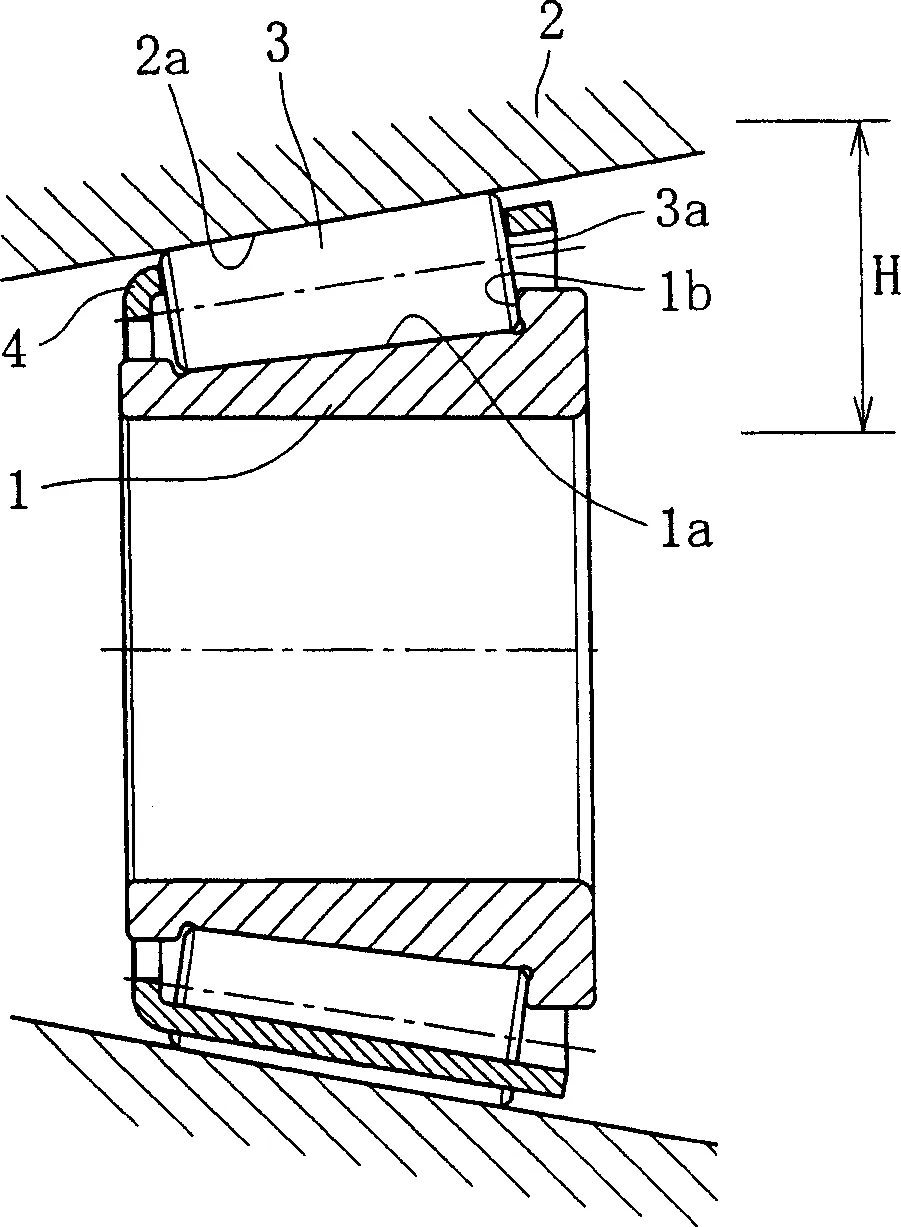
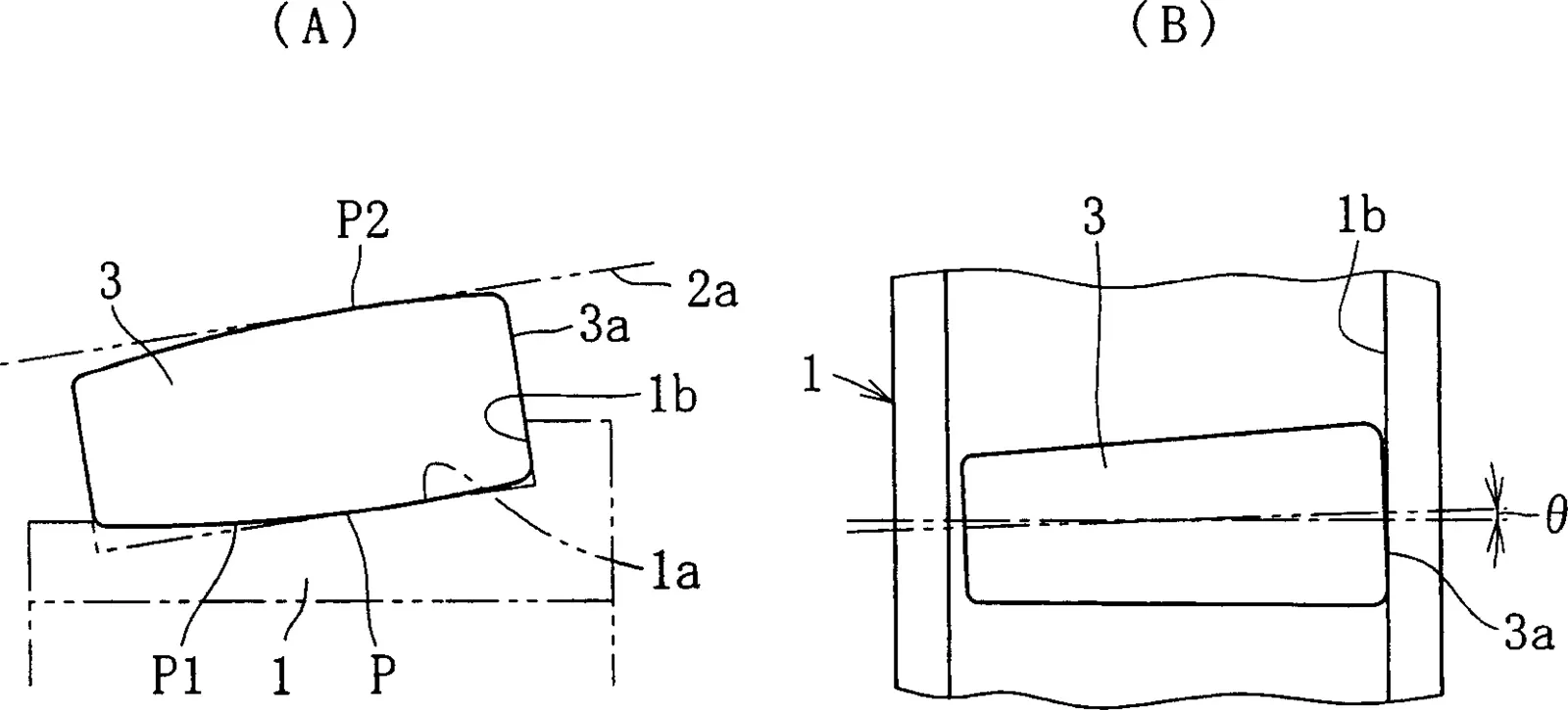
Figure 1 shows the flowchart of machining tapered rollers.
Figure 2 illustrates the results of the peeling test on tapered roller bearings.
Figure 3 shows a cross-sectional view of a tapered roller bearing used to support a typical automotive transmission rod section.
Figure 4A is a side view of a tapered roller with a convex surface, and Figure 4B is a plan view of a tapered roller with a convex surface.
Specific implementation methods
The following will refer to the accompanying drawings to describe embodiments of the present invention.
Figure 1 shows a method for processing rollers in a tapered roller bearing of the present invention. Firstly, use grinding to process the convex surface of the tapered roller. Next, continue to perform drum polishing or barrel polishing on the surface of the tapered roller with convex machining until the grinding stripes disappear.
Assemble tapered roller bearings using the processed rollers mentioned above and test for peeling damage to the bearings. Figure 2 shows bearing C related to the present invention and bearing A tested as a comparative example under the same conditions B, The results of the experiment compared with D. Each roller of bearings A to D has the same convex surface formed by grinding.
The entire convex surface of bearing A is finely machined by super machining of rollers. The overall surface roughness is good, but high cost machining is required for the bearing. In bearing B, only the center of the convex surface of the roller is precision machined through super machining, leaving some grinding stripes. Bearing C has the entire roller that is precision machined through barrel processing, and compared to the use of super machining, its entire surface roughness is higher and there are no grinding stripes left. Bearing D has rollers that have not been processed except for the convex surface. Compared to the roughness of bearing C, its roughness is smaller, but some grinding stripes remain on the entire surface.
This experiment has revealed that the presence of grinding stripes causes peeling damage, and the absence of grinding stripes does not cause peeling damage even when the surface is rough.
Assuming that the tip of the stripe is subjected to erosion and grinding, causing detachment of the orbital surfaces of the opposing objects, namely the inner and outer rings. As support for this hypothesis, when comparing the skewness (Rsk), it was found that bearing C was -2.6 because its protrusion was flattened by drum machining. This means that its surface is in a concave state (the protrusions of the grinding stripes become rounded). On the other hand, bearing D is -0.3 because it has not undergone any processing other than grinding. This means that its surface is in a state where the protrusions and depressions are almost at the same height (the protrusions of the grinding stripes become sharper).
In short, providing precision machining by flattening the protrusions caused by grinding using drum machining may result in low-cost production of bearings including rollers with large convex surfaces that do not cause problems such as peeling damage.
In addition, in the case of using tapered roller bearings without sufficient lubrication, coating with molybdenum disulfide (MoS2) can be used for final touch polishing along with drum polishing or barrel polishing to reduce roller wear caused by misalignment. Due to the fact that this coating process can be carried out together with drum polishing or barrel polishing, wear resistance measures may be taken in an inexpensive and effective manner without requiring any additional processing steps.
The above description is only provided for one embodiment of the present invention. The present invention is not limited to the above embodiments and can be modified in various forms, as long as it remains consistent with the technical ideas described in the claims.
2024 June 1st Week WBM Product Recommendation:
Rolling Dies:
As one of the professional tool manufacturer, provides rolling die with high hardness,fast delivery and good service.
https://www.bearingroller.com/tools/rolling-dies.html