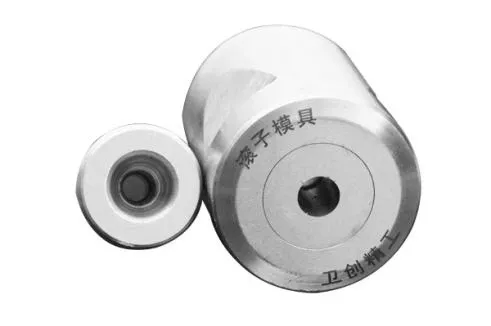
Abstract: The global manufacturing industry relies on billions of perfectly spherical steel balls, the fundamental component in bearings, guides, and countless other mechanisms. The creation of these spheres, however, hinges on a critical and often unsung hero: the cold heading die. This article explores the advanced material science, precision engineering, and rigorous quality control that define high-performance cold heading dies, the tools that transform wire into perfect spheres through immense force.
Material Characteristics: The Bedrock of Durability
The core challenge for a cold heading die is to withstand extreme cyclic pressures, abrasive wear, and metal-on-metal adhesion. Standard tool steels are insufficient. The materials of choice are thus engineered for supreme toughness and wear resistance.
Carbide Excellence: The industry benchmark is tungsten carbide, specifically fine-grained or ultra-fine-grained grades. This material, composed of hard tungsten carbide particles bound in a tough cobalt matrix, offers an unparalleled combination of compressive strength and wear resistance, far surpassing any tool steel.
Advanced Coatings: To further enhance performance, die cavities are often treated with Physical Vapor Deposition (PVD) coatings, such as Titanium Nitride (TiN) or Titanium Carbonitride (TiCN). These ultra-hard, low-friction coatings significantly reduce galling (material pick-up) and abrasive wear, extending die life and improving the surface finish of the produced balls.
Substrate Hardness & Toughness: The carbide substrate is meticulously engineered to achieve a perfect balance. Extreme hardness (typically >90 HRA) resists deformation, while a controlled cobalt content provides the necessary toughness to prevent chipping or catastrophic failure under high-impact loading.
Precision Manufacturing Process: From Blank to Masterpiece
Creating a cold heading die is a symphony of advanced machining and metrology, where tolerances are measured in microns.
CNC Grinding & Shaping: The process begins with a precision-ground carbide blank. Using state-of-the-art CNC grinding machines with diamond-impregnated wheels, the initial hemispherical cavity is formed. This step requires exceptional skill to achieve the required pre-form geometry.
Micro-Polishing & Lapping: This is the most critical and specialized phase. The ground cavity undergoes a series of meticulous polishing and lapping operations using diamond compound pastes of progressively finer grits, down to sub-micron levels. This painstaking process eliminates all microscopic imperfections and grinding marks, achieving a mirror-like, Ra < 0.05 µm surface finish. A perfect polish is non-negotiable; any surface flaw will be imparted onto every single ball produced and can become a nucleation point for die failure.
Final Inspection & Preparation: The finished die cavity is rigorously inspected using precision plug gauges and optical comparators to verify its perfect spherical form and diameter. It is then assembled into a hardened steel die case, ready for installation in the cold heading machine.
Stringent Quality Control: A Zero-Defect Mandate
Given the high-volume production runs, a single die flaw can result in millions of defective balls. Quality control is therefore exhaustive.
Dimensional Integrity: Every die is 100% inspected for critical dimensions, including cavity diameter, roundness, and sphericity, using high-precision air gauging or laser scanning.
Surface Finish Analysis: White Light Interferometry or high-magnification digital microscopes are used to quantitatively measure and qualify the surface roughness, ensuring it meets the specified super-finish standard.
Material Certification: The carbide grade and cobalt content are certified, and hardness is verified to ensure it meets the specified mechanical properties.
Production Trial & Sample Analysis: A first-article sample run is mandatory. Balls produced from the new die are analyzed for their own geometry, surface finish, and microstructure to validate that the die performs as intended before it is released for full-scale production.
Application Fields: The Heart of Ball Manufacturing
Cold heading dies are the heart of the steel ball manufacturing process, which is itself central to numerous industries.
The Bearing Industry: The primary application. These dies produce the vast quantities of balls used in deep-groove ball bearings, angular contact bearings, and thrust bearings for everything from electric motors to automotive wheels and aerospace systems.
Automotive Sector: Beyond bearings, balls are used in constant velocity joints, transmission systems, and valves.
Consumer & Industrial Goods: Found in products ranging from bicycles and skateboards to precision guides in computer hard drives and medical devices.
The Cold Heading Process Itself: A wire feedstock is sheared into a slug, which is then pressed between two of these precision dies in a cold heading machine. The immense pressure causes the metal to flow plastically into the spherical cavities, forming a near-net-shape ball with minimal material waste, which is then finished through grinding and lapping.
Conclusion: A cold heading die is far more than a simple tool; it is a masterpiece of precision engineering. Its performance directly dictates the quality, cost, and efficiency of the entire ball manufacturing process. By leveraging advanced carbide materials, sub-micron finishing techniques, and uncompromising quality standards, these dies enable the mass production of the perfect spheres that keep the modern world in motion.
2025 November 3rd Week WBM Product Recommendation:
Quill:
WBM produces taper roller dies with high efficiency and automation. Rollers are formed on a single automatic cold heading press and are fed, cut, and punched into the die for five steps.
We can produce different types and sizes taper roller dies with quality assurance,include:Combination Punch,Outside Sleeve,Blade,Combination Punch,Feed Cylinder,Combination Dies,Double Layer Sleeve,Insert.