(4) Precision forging of rod-shaped fasteners
The precision forging of rod-shaped fasteners is the process of forging the pre formed blank head in the working cavity between the upper and lower molds to obtain the final shape and size of the product head.
The deformation of the head varies depending on the geometric dimensions of the product's head, and generally has the following forms:
a. Hexagonal and square head bolts
The forming area shown in Figure 36-19 consists of three regions. One third of the head height is formed in the upper mold cavity, one-third to two fifths are formed in the lower mold cavity, and the rest form flying edges in the gap between the upper and lower molds. Finally, the trimming process is used to complete the trimming of hexagonal and square heads.
b. Half round head and flat round head machine screws, with the head completely formed in the upper mold (optical punching) cavity.
c. Internal hexagonal cylindrical head screws, concave hexagonal head bolts and other products, with the head formed in the lower mold cavity. Because it is precision forging, the working cavities of both the upper and lower molds must meet the requirements of the product head size.
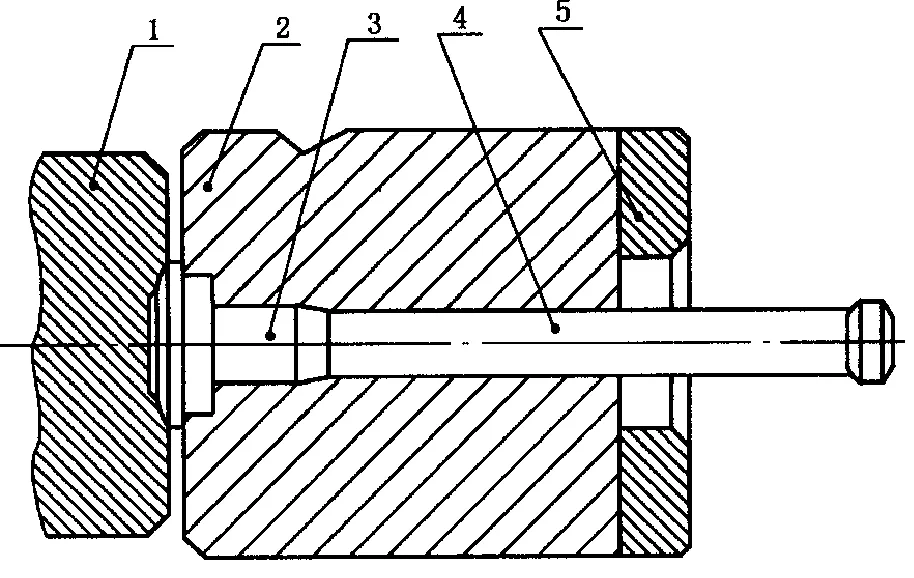
1. Initial upsetting mold; 2 concave molds; 3 pieces; 4. A top pole; 5 cushion blocks
Figure 36-19 Schematic diagram of cold hexagonal head and square head
(5) Shrinkage process of rod-shaped fasteners
Hexagonal head bolts are widely used fasteners, with a wide range of strength levels produced from 3.6 to 12.9. For hexagonal bolts of medium and low strength levels, two processes are generally used for production: thin rod process and thick rod diameter reduction process. The so-called thin rod refers to the use of wire with a diameter equivalent to that of the thread blank for cold heading. The wire size changes very little, and the rod can be directly threaded; Coarse rod is made of wire with a diameter larger than the outer diameter of the thread. In the cold heading process, one, two, or more diameter reductions are arranged to make the length of the thread reach the size of the thread blank.
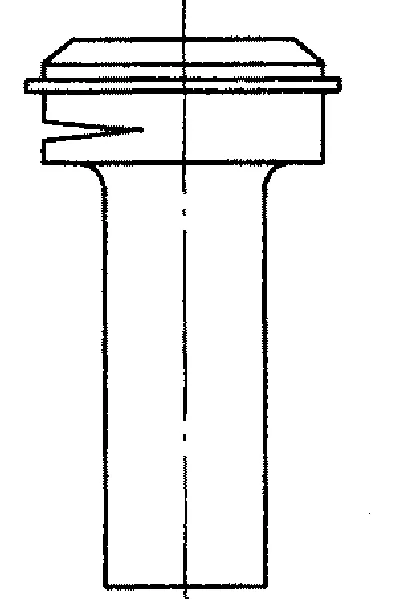
Figure 36-20 Schematic diagram of folding of bolt heads of shovel thick and thin rods
Internal hexagonal cylindrical head screws are high-strength products of grade 8.8 or above according to national standards. Although the deformation of the head is not significant, the wire used has high strength and corresponding low plasticity. Therefore, the coarse rod diameter reduction process is commonly used, which involves one or more times of diameter reduction during cold heading to make the diameter of the threaded rod reach the size of the screw blank.
Hexagonal head bolts use thin rod technology, and the degree of deformation of the head during cold heading is relatively increased compared to thick rods. It is suitable for the production of short specification fully threaded products.
The production of bolts using thin rod technology often has the following problems:
The degree of deformation of the head is large, and it is easy to produce cracks. Sometimes, cutting the hexagonal edge cracks cannot completely remove them.
During the upsetting process, the head often undergoes longitudinal bending due to significant deformation, resulting in folding at a distance of 1/3 from the support surface, as shown in Figure 36-20, and causing the bolt to turn around.
The poor bonding strength between the head and the rod becomes a hidden danger for the thin rod bolt to turn around. The use of thick rod diameter reduction technology avoids the above problems. However, due to the need for diameter reduction, it not only increases the reduction force, but also makes the mold structure correspondingly complex.
It must have a reducing die, usually processed with hard alloy, which increases the cost of the mold.
In addition, there are special requirements for surface lubrication and material hardness of the wire. Most of the wire used in production has undergone phosphating and saponification treatment. The hardness of the wire after spheroidization annealing should be 75-85 HRB.
Overall, although the process of reducing the diameter of thick rods requires high requirements for wire and molds, which increases production costs, it can reduce product cracking caused by poor material plasticity in terms of product quality. Improved material utilization rate, ensured product strength requirements, and overall economic efficiency is still good.
2026 July 5th Week WBM Product Recommendation
Spherical Roller:
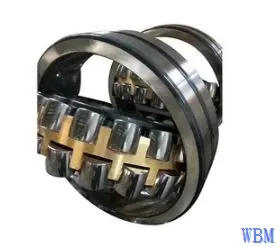
Spherical roller bearings have two rows of symmetrical rollers, a common sphere outer ring raceway and two inner ring raceways inclined at an angle to the bearing axis. The centre point of the sphere in the outer ring raceway is at the bearing axis.
https://www.bearingroller.com/rolling-elements/taper-roller/spherical-2roller.html