
The development of green and efficient steel-making continuous casting process to produce high load bearing steel balls has become the industry's pursuit goal
I. Research background and problems
The national "double carbon" development strategy promotes the rapid development of clean energy, high-end equipment and other fields. For example, the wind power generation will increase from less than 10% at present to more than 50% in 2060. Large load bearing steel balls are the key core components of major projects and equipment such as wind power generation, and are an important guarantee for the realization of national strategies such as "made in China" and "energy security". As we all know, the technical difficulty of rolling elements in bearing materials is greater than that of ferrules, and the difficulty of steel balls is greater than that of rollers and needles. Compared with other bearing steel balls, high-load bearing steel balls have the following technical difficulties: ① greater load: crushing load is more than 2500kN, and working stress is more than 1250kn, so they are more sensitive to fatigue failure; ② Larger size: large load steel ball size up to Φ 89mm (corresponding bar specification is Φ 60mm), it is difficult to control the uniformity of steel structure; ③ Worse service environment: the wind power bearing is free of maintenance during the whole life cycle. It is used in low temperature, corrosion and other harsh environments. The P content of steel is required to be ≤ 0.010%.
Based on the above characteristics, the large load bearing steel ball requires that the number of inclusions in the steel is small and the size is small, the carbides are fine and uniform, and the content of harmful elements such as P is low. At present, the domestic and foreign production can only adopt the mold casting process, but this process has the problems of high energy consumption, low production efficiency, and high manufacturing cost. Therefore, the development of green and efficient steel-making continuous casting process to produce steel for heavy load bearing steel balls has become the industry's pursuit goal. If it can be successfully overcome, it can fill the gap at home and abroad, and only the metal yield will increase from about 83% of mold casting to more than 96% of continuous casting.
Although with the continuous progress of technology in the metallurgical industry, the phosphorus content of bearing steel and the purity of molten steel have no longer become the limiting links for the quality improvement of bearing steel, some special steel enterprises can also use continuous casting process to produce small specifications( Φ However, there are few research reports on how to quickly control the P content of molten steel to within 0.010% and the total oxygen of steel to within 5ppm under the high-efficiency converter (oxygen supply intensity reaches 5.0Nm3 / min / t) and fast-paced refining mode, and how to stably produce large-sized and long-life bearing steel balls by continuous casting process. Therefore, Jiangsu Zhongtian iron and Steel Group Special Steel Co., Ltd. aims at the production of high load bearing steel ball steel by green and efficient steel-making continuous casting process. The project needs to solve the scientific and technical problems and industrial common problems such as high-efficiency and low phosphorus content control of converter, high-speed refining of molten steel purity control, low center segregation and high organization uniformity control.
Ⅱ. Ideas and technical solutions for solving problems
Large load bearing steel balls have been used for a long time under high alternating stress such as impact, compression and shear. Meanwhile, some of them have been used in cold areas, such as wind turbine bearing steel balls, which have the characteristics of "large load, large specification and long life". In order to meet the stringent quality performance of large load bearing steel balls, the quality indicators of steel are required to be: ① high cleanliness, small inclusions (DS ≤ 0.5), small quantity and low oxygen (T) O ≤ 5ppm, low calcium [Ca] ≤ 2ppm, water immersion high-frequency ultrasonic flaw detection qualified (10MHz + 21db gain); ② The microstructure and properties are uniform, the carbon segregation index of rolled billet is ≤ 1.05, the net shape is ≤ 2.5, and the band shape is ≤ 2.0; ③P≤0.010%.
Therefore, the project focuses on the three core technologies of "green efficiency, super cleanliness and high organizational uniformity". The main research ideas and contents are as follows:
1. Study on low phosphorus control technology of high efficiency converter
The traditional converter smelting low phosphorus bearing steel (phosphorus content ≤ 0.01%) generally adopts the double slag method or double combination method, and the oxygen supply intensity is ≤ 3.5nm3 / (min · t). The production efficiency of this smelting mode is low, and the smelting cycle will be extended for more than 5min. Adopting the single slag method and increasing the oxygen supply intensity of the converter is the most effective way to shorten the smelting cycle of the converter. However, it will lead to a series of problems, such as accelerating the decarburization rate, easy drying in the furnace, deteriorating the dephosphorization effect and increasing the probability of splashing. Based on the problems existing in high-intensity smelting of converter, the high-efficiency and ultra-low phosphorus smelting process of converter is developed by studying the dephosphorization law of converter smelting process and combining the multiphase slag dephosphorization technology.
According to the dephosphorization mechanism of converter, the distribution law of phosphorus in converter slag is studied. Figure 1 shows the mineral phase composition of converter slag. It can be seen that P mainly exists in C2S-C3P phase. Therefore, increasing the proportion of C2S-C3P phase can improve the dephosphorization effect of converter slag.
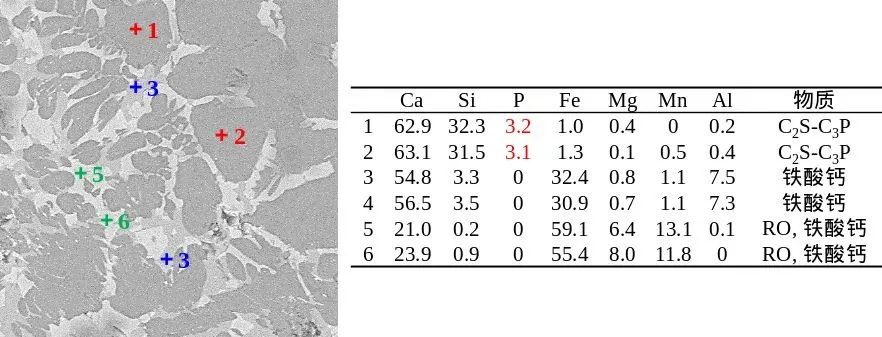
Fig. 1 mineral phase composition of rotary furnace slag
With the help of the thermodynamic software FactSage and in combination with the industrial production data, it is concluded that reducing the FeO content in the slag can increase the C2S-C3P phase ratio in the slag. For example, taking 50% CaO + 20% SiO2 + 10% MgO + XFeO + 5% P2O5 as an example, it is found that the C2S-C3P phase ratio gradually increases with the decrease of the FeO content in the slag, as shown in Fig. 2.
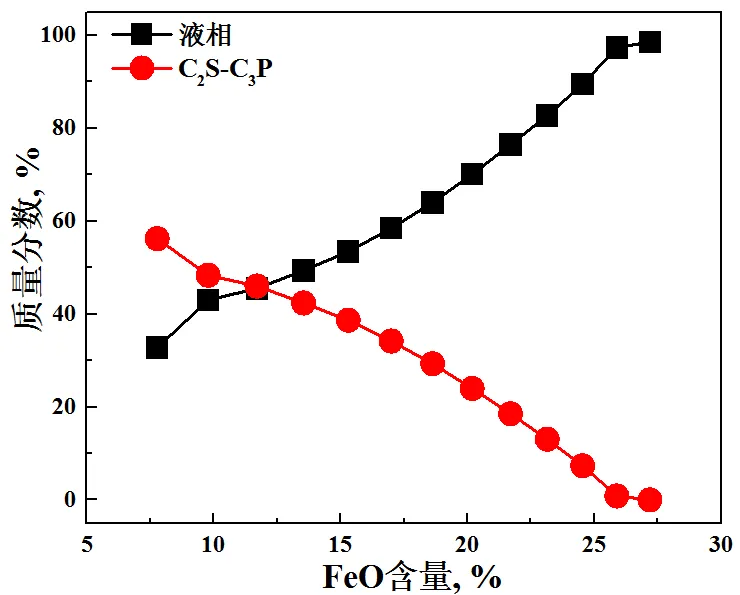
Fig. 2 Effect of FeO on C2S-C3P phase ratio
Fig. 3 shows the C2S-C3P phase control results of converter slag. It can be seen that the FeO content of converter slag can be reduced from 16-20% before optimization to 10-12% by pressing the gun for 1-2min before the end of blowing. Under the condition of properly reducing the basicity of converter slag, a higher proportion of C2S-C3P phase can still be obtained.
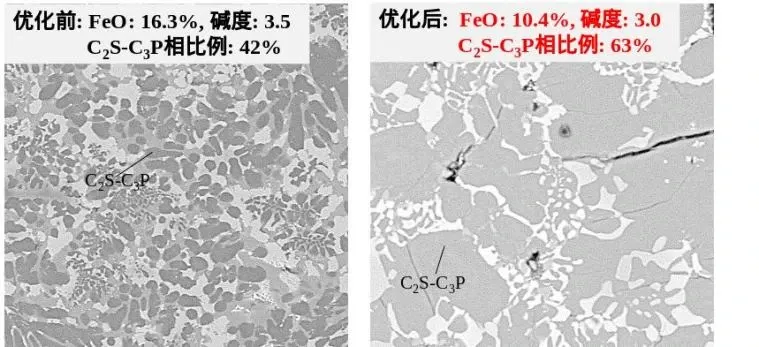
Fig. 3 C2S-C3P phase ratio in converter slag before and after optimization
Fig. 4 shows the effect of oxygen supply intensity on oxygen supply time. It can be seen that when the oxygen supply intensity is increased from 3.5Nm3/min/t to 5.0Nm3/t/min, the average oxygen supply time can be shortened by 3.1min.
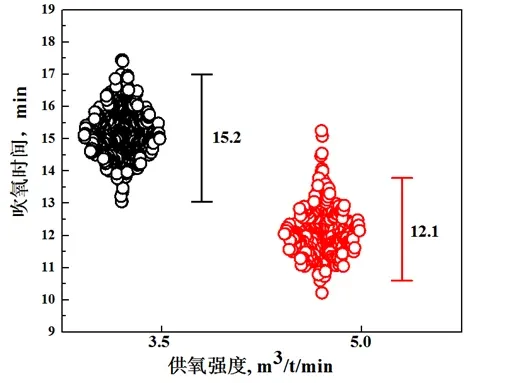
Fig. 4 Effect of oxygen supply intensity on oxygen supply time
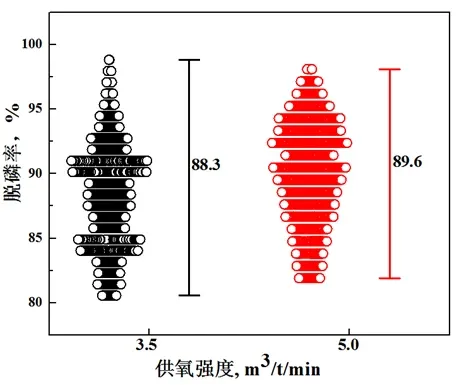
Fig. 5 Effect of oxygen supply intensity on Dephosphorization
Fig. 5 shows the effect of oxygen supply intensity on dephosphorization. It can be seen that by increasing the proportion of C2S-C3P phase in converter slag, even if the oxygen supply intensity is increased from 3.5Nm3/min/t to 5.0Nm3/t/min, the dephosphorization capacity of converter slag is further improved compared with the original process, and the high-efficiency and low-cost smelting of low phosphorus steel is finally realized.
2. Study on fast-paced ultra clean external refining technology
Traditionally, it is believed that long-time refining is easier to improve the purity of molten steel, so the refining time of bearing steel is usually controlled to 80 ~ 120min. It is found that when the refining time exceeds 30min, the removal effect of inclusions is not significant with the extension of the refining time. At the same time, the slag steel reaction for a long time will lead to the transformation of inclusions from initial solid alumina or magnesia alumina spinel inclusions to low melting point calcium aluminate, resulting in the failure of efficient removal of inclusions in the subsequent RH process and ultimately affecting the purity of molten steel.
This research breaks the traditional thinking. On the one hand, it develops a fast-paced and high-efficiency refining process to suppress the slag steel reaction in the refining process by controlling the refining time within 40min. At the same time, it studies the influence of the alloy on the inclusion composition and finds a method to eliminate the influence of the alloy on the inclusion. Finally, it realizes the control of the solid alumina and magnesia alumina spinel inclusions. With the help of the powerful vacuum treatment of RH, The high-efficiency removal of solid alumina and magnesia alumina spinel inclusions is realized. Since the removal efficiency of solid alumina and magnesia alumina spinel inclusions is extremely high in the RH process, even if the RH high vacuum (< 67pa) treatment time is shortened from the initial 25-30min to 15min, the average total oxygen of steel can be reduced from the initial 6ppm to 5ppm.
Fig. 6 shows the implementation effect of the optimized process. It can be seen that through the optimization, the refining time is shortened from 80-120min to 30-40min in the original process, and the stirring strength of molten steel is controlled in the refining process. After the refining, the solid magnesium aluminum spinel inclusions are controlled.
(a) Inclusion composition at the end of LF; (b) Total oxygen of bearing steel (2021)
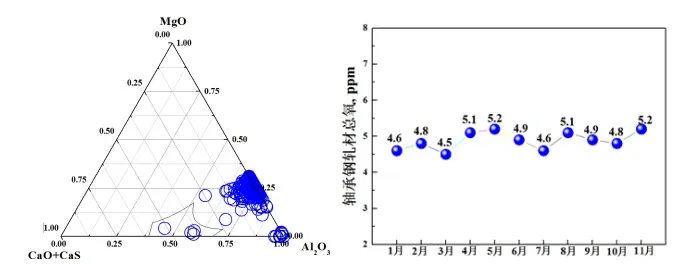
Fig. 6 control results after process optimization
3 Study on new tundish metallurgy technology
By controlling the inclusions of bearing steel to solid alumina and magnesia alumina spinel, nodulation will occur in the continuous casting process, affecting the smooth production (the number of continuous and stable casting furnaces is generally ≤ 6). At the same time, part of the nodulation will randomly peel off into the steel, forming macro large-scale inclusions, which will seriously deteriorate the cleanliness of the steel. In view of this problem, a new type of tundish metallurgy technology has been developed, that is, a horizontal electromagnetic stirring (Name: tundish homogenizer) is installed in the tundish. Its purpose is to drive the high-efficiency flow of molten steel in the tundish, promote the floating of inclusions, further improve the purity of molten steel, achieve the goal of reducing nozzle nodulation, and solve the technical problems of poor castability of bearing steel and low macro inclusion qualification rate. At the same time, under the action of electromagnetic force, the temperature between each flow is uniform, and the temperature difference between the two sides of the tundish can be reduced from 3 ~ 5 ℃ of the original process to 1 ~ 2 ℃.
Fig. 7 shows the inspection results of the number of inclusions in the casting slab. It can be seen that the number of inclusions in the casting slab is further reduced after electromagnetic stirring is applied to the tundish, which indicates that the purity of molten steel can be further improved when electromagnetic stirring is applied to the tundish. Fig. 8 shows the influence of electromagnetic stirring on the rising speed of stopper rod in tundish. As the purity of molten steel in tundish is further improved, the rising speed of stopper rod is significantly reduced after electromagnetic stirring is applied. After electromagnetic stirring is applied to tundish, the number of continuous casting furnaces of molten steel can be increased from 6 to 8. Figure 9 shows the temperature difference of molten steel at both sides of tundish. It can be seen that after electromagnetic stirring is applied to tundish, the temperature difference of molten steel at both ends of tundish can be reduced from 3 ~ 5 ℃ in the original process to 1 ~ 2 ℃.
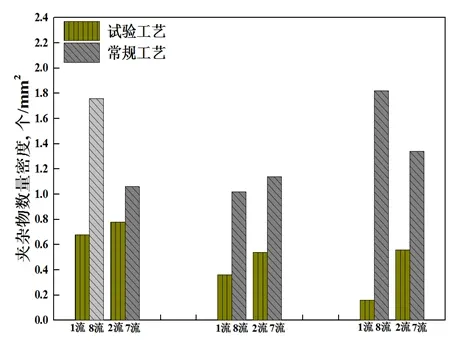
Fig. 7 Effect of electromagnetic stirring in tundish on the number of inclusions in billet
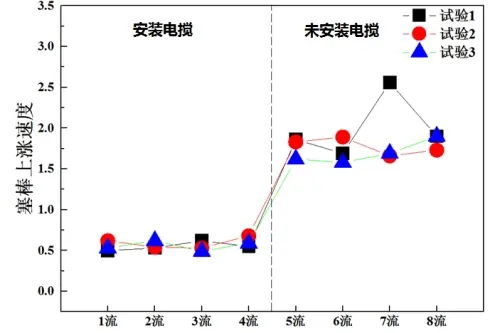
Fig. 8 Effect of electromagnetic stirring in tundish on rising speed of stopper rod
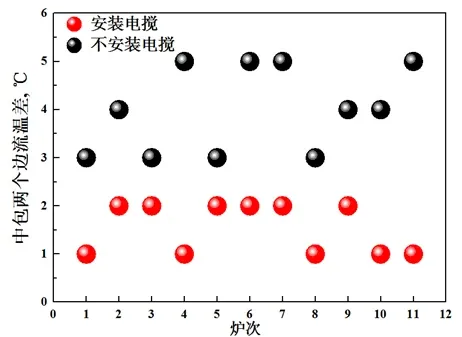
Fig. 9 Effect of electromagnetic stirring in tundish on temperature uniformity of molten steel
4. Research on precise dynamic continuous casting process under high pressure and high temperature diffusion technology
The traditional large load bearing steel ball is produced by die casting process. The main reason is that the control of carbide non-uniformity of bearing steel ball produced by continuous casting process can not meet the requirements. With the popularization of soft reduction technology, although the control ability of carbon segregation has been enhanced, it still faces the problem that it is impossible to find the solidification end point accurately and apply reasonable reduction. In this project, the dynamic solidification simulation of bloom is established? In combination with the lead filling test and the analysis of the reduction crack, we master the position of the solidification end and the change law of the solid rate, solve the key process theory problem of "where to press and how to press", develop the multi factor coupling process technology of "superheat, secondary cooling strength, speed and dynamic high pressure", and overcome the control problem of the central segregation in the continuous casting process. When the total reduction reaches 20-25mm, the carbon segregation index of the billet is controlled at 1.06-1.10. By studying the influence of holding temperature and time on high-temperature diffusion effect, a flexible process with high efficiency and energy saving and high-temperature diffusion is developed. When the soaking temperature of continuous casting slab under high pressure is 1240 ° C + soaking time is 8h, the central carbon segregation index reaches 1.05 and the band shape ≤ 2.0.
Fig. 10 shows the control results of carbon segregation of the cast slab after applying high pressure. It can be seen that the average value of carbon segregation index of the cast slab can reach 1.06 ~ 1.10.
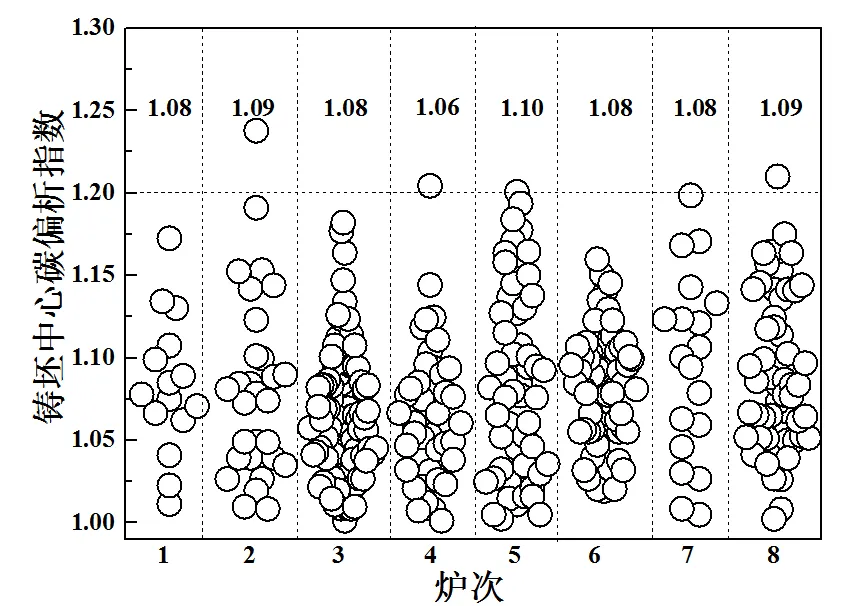
Fig. 10 control results of carbon segregation of bearing steel billet
Fig. 11 shows the morphology of carbide band structure before and after the optimization of high load bearing ball steel by continuous casting under high pressure + high temperature diffusion process (holding at 1240 ℃ for 8h). Among them, through high temperature diffusion annealing process, the carbon segregation of cast billet is further reduced from 1.06 ~ 1.10 to 1.05, and the carbide band structure of rolled material is reduced from 3.0 to ≤ 2.0.
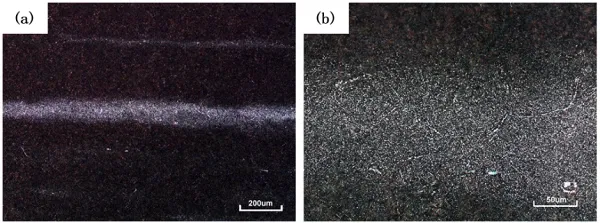
Figure 11 Φ Carbide band shape before and after 60mm improvement:
(a) 100 before improvement ×; (b) 500 before improvement ×; (c) 100% after improvement ×; (d) 500 after improvement ×
5. Research on on-line structure control technology of large size bearing steel bar
Carbon control of large-scale continuous casting bearing steel bar mesh is a common technical problem in the industry. In view of the key process theory problems caused by such factors as core temperature "black box", large core surface temperature difference, insufficient rolling control capacity and cooling control capacity, the dynamic CCT, dynamic phase transformation and the temperature field of controlled rolling and cooling process are studied through Gleeble thermal simulation test, Developed large size bearing steel bar with core temperature control γ+ The on-line structure control technology of controlled rolling in Fe3C two-phase zone, high-temperature recrystallization zone and sectional ultra fast controlled cooling after rolling, and the stable control of network carbide ≤ 2.5 grade.
Fig. 12 microstructure of 100crmnsi6-4 after two passes of hot compression
(a)850+840℃; (b)850+800℃; (c)850+760℃; (d) 850 + 720 ℃ - 20 ℃ / s cooling to 600 ℃
Ⅲ. Major innovative achievements
The project initiated the continuous casting process to replace the mold casting and import, focused on the process research and innovation of green emission reduction, high quality and high efficiency, energy saving and consumption reduction, successfully solved the key control technology of steel for large load bearing steel balls, and realized industrial application. Main technical innovations of the project:
1. It is the first set of key technologies for manufacturing bars for heavy load bearing steel balls by continuous casting instead of die casting. The finished product rate was increased by about 13%, and the carbon emission in the product life cycle was reduced by 105.3kg/t, a decrease of 4.3% (data from China Metallurgical planning and Research Institute), and large-scale industrial application was realized;
2. A fast-paced and clean smelting process technology combining "high-efficiency dephosphorization of converter + large wetting angle control of LF inclusions + RH strong circulation" was developed. The efficiency was increased by about 30%, and the bearing steel DS ≤ 0.5, low oxygen t.o ≤ 5ppm, low calcium [Ca] ≤ 2ppm, and high-frequency water immersion flaw detection qualification rate ≥ 99% (10MHz + 21db gain) were realized;
3. The multi factor coupling process technology of "tundish homogenization technology + continuous casting billet precise dynamic large pressure reduction + high temperature diffusion process" was developed, and the technical problem of central segregation in continuous casting process was solved. The carbon segregation index of rolled billet was ≤ 1.05 and the band carbide was ≤ 2.0;
4. Developed large size bearing steel bar with core temperature control γ+ The on-line structure control technology of controlled rolling in Fe3C two-phase zone and recrystallization zone and sectional ultra fast controlled cooling after rolling, and the stable control of network carbide ≤ 2.5 grade.
Ⅳ. Application and effect
The project integrates a variety of innovative technologies. It is the first to adopt the continuous casting and rolling process flow of "molten iron of blast furnace → converter → refining → vacuum degassing → bloom continuous casting → heating and blooming → controlled rolling and cooling". It has successfully overcome the key control technology of steel for large load bearing steel balls and realized the substitution of mold casting and import.
The project achievement evaluation committee believes that the achievement has generally reached the international leading level. The products of the project are widely used in large load bearing steel balls of wind power, shield machines, large excavators and other major engineering equipment, providing high-quality raw materials for international and domestic well-known bearing steel ball customers. In the past three years, a total of 102000 tons were sold, and the accumulated net profit reached 153 million yuan, Make positive contributions to the technological progress of China's high-end bearing manufacturing industry chain.
More about WBM Steel Ball:
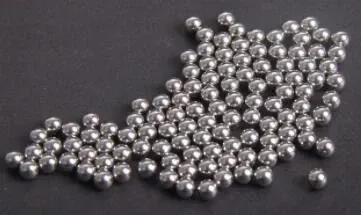
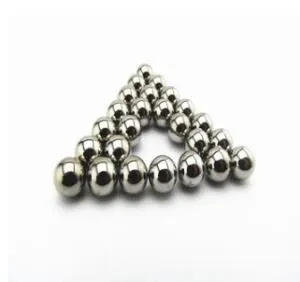
Bearing steel balls are important basic components in the industry. Bearing steel balls have a long history of use in the precision bearing industry and life, and are more widely used. It can be said that steel balls exist in most places where there is rotation, commonly known as steel balls and balls. Steel balls are widely used in bearings, hardware, electronics, iron art, mechanical equipment, electric power, mining, metallurgy and other fields.
WBM now have the ability to supply full set tooling for Modler taper roller grinding line. Their tools are well fitted in customer modler centerless grinder and modler end face grinder. And help customer produce high precision rollers with low cost.
WBM has obtained the certificates of ISO9001:2000 and ISO/IATF16949, The outstanding reputation of WBM is built on our core management principles: technical innovation, high output quality and efficiency, hard-working, meeting and beyond clients’ expectation. WBM spares no effort in creating maximum value for customers.