
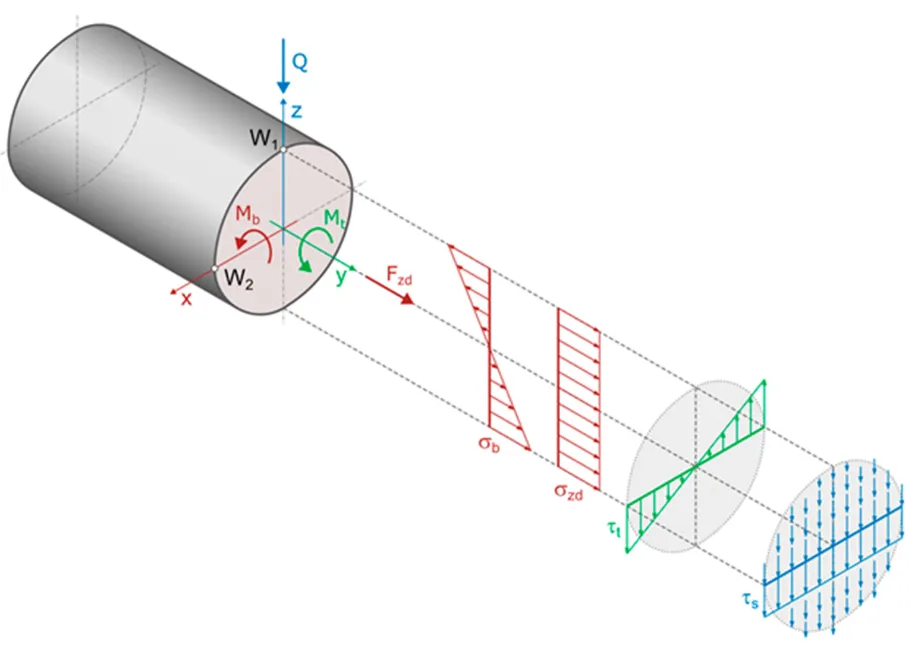
Bearing forces depend on the loads applied on the related shaft. The signs of torque and speed applied on the shaft are not relevant for bearing verifications. But speed variation must be considered, so the extended simple-counting method , generating a load spectrum with load and speed distribution, is the appropriate method.
Shafts in drive systems are submitted to bending, axial tension/compression, torsion, and shear stresses. A point on the outer diameter of a rotating shaft is submitted to tensile stress in one position and to compression stress when rotated by 180° . Therefore, a rotating shaft with gears submitted to a varying torque - when the torque changes slowly (much slower than the shaft speed)-is basically submitted to alternating bending and shear stress. In contrast, torsional stress is nearly constant, changing much slower according to the changes of the applied torque. In simplified calculations, torsion is often assumed to be pulsating (assuming that the torque is pulsating with every rotation). This assumption is on the safe side, as normally the change in torsion per rotation is much less.
If the real number of torque changes is extracted from time-torque data by the rainflow method, then the torsion stress distribution is more realistic and will provide improved results. The same considerations apply also to axial tension/compression stresses.
The rainflow analysis delivers the upper torque Thigh and the lower torque Tlow of a load spectrum bin. For a shaft calculation according to the FKM rule (Ref. 5) the upper torque Thigh and the stress ratio factor R is used (see Equation 1). Thus, a load spectrum bin must additionally contain the R factors for torsion and axial tension/compression according to Equation 1, and R = -1 for bending and shearing. For further handling of Thigh and R see the section "Rating of Bearings with a Load Spectrum."
Note that in the shaft section, where bending and torsion stresses are combined, often the bending stress dominates, making the influence of torsion minimal. In such cases, assuming that torsion is pulsating is acceptable. The advantage of this simplification is that shaft and bearing calculations can use the same load spectrum (Type A according to Table 2).
More About WBM:
Founded in 1988,WBM is a professional provider of bearing cold heading dies, taper rollers, grinding tools and detection equipment and comprehensive service of consultation/trading in supply chain of the bearing industry. Designing, production, sales, service and survey are all included in the quality management system.
https://www.w-bm.com/
2024 New Week WBM Product Recommendation:
Cutter:
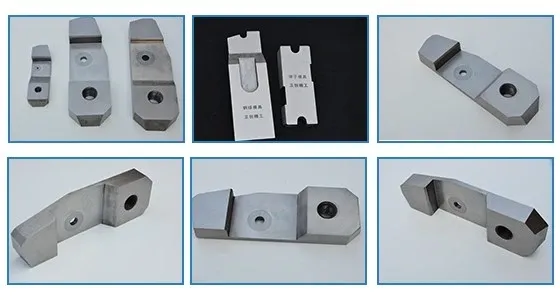
WBM produces taper roller dies with high efficiency and automation. Rollers are formed on a single automatic cold heading press and are fed, cut, and punched into the die for five steps.
We can produce different types and sizes taper roller dies with quality assurance,include:Combination Punch,Outside Sleeve,Blade,Combination Punch,Feed Cylinder,Combination Dies,Double Layer Sleeve,Insert.
Contact Us:
Tel: +8615937969996
Email: info@w-bm.com
Website: www.bearingroller.com