
Abstract: Plug valve is a very common type of valve in gas pipelines, which has extremely high applications in throttling, venting, and sewage pipelines. Due to the possibility of a large amount of impurities in the medium inside the above-mentioned pipeline, it is easy to cause damage to the sealing surface during frequent operations. If the damaged sealing surface is not treated and protected in a timely manner, the valve will experience internal leakage, affecting the safety production and operation of the station team. Starting from this current situation, this article proposes a simple and economical method for dealing with damaged sealing surfaces of plug valves through multiple experiments and research, providing reference for relevant units concerned about this issue.
Keywords: plug valve; Structure; Internal leakage; grind
1. Overview
Plug valves and ball valves are the two most common types of valves in gas transmission stations, and they are also valves that require frequent periodic maintenance. Due to the throttling function of the plug valve, the applicable working conditions are more severe compared to ball valves, and it is more prone to difficulties in opening and closing, internal leakage, and other situations. At present, for plug valves with internal leakage, methods such as cleaning the valve, adding lubricating grease or sealing grease, and reducing the number of switches are generally adopted for treatment. These methods can solve or alleviate the internal leakage of the plug valve, but when the sealing surface of the plug valve is damaged, the above methods cannot fundamentally solve this problem. If the maintenance operation is improper, it will further expand the situation of internal leakage, which will have a negative impact on the normal gas transmission operation in the station.
This article proposes a convenient, economical, and low demand grinding method for tools, which reduces the threshold of grinding and facilitates the application of ordinary maintenance workers in the maintenance of plug valves. It also takes less time and has low requirements for the workplace, reducing the offline maintenance time of plug valves and making it easy to cope with various complex on-site conditions.
2. Analysis of the current situation of handling cock scratches
Due to the fact that plug valves can be used as throttle valves, compared to ball valves, plug valves are more likely to form slight scratches on the surface of the plug, thereby affecting the sealing effect of the plug valve. In response to the current situation, the following three methods are commonly used for emergency response: 1. Tighten the loading screw, increase the contact force between the plug and the valve body, and thereby enhance the sealing effect; 2. Soak in cleaning solution for 24 hours, clean the dirt inside the plug valve, and then add lubricating grease or sealing grease to fill the gap between the scratches and the valve body; 3. Reduce the number of times the valve is opened and closed, and use the above two methods to protect the valve and extend its service life. At present, these three methods can effectively alleviate the degree of internal leakage in the plug valve, but they cannot change the reality of scratches on the plug. If there are many impurities between the plug and the valve body, the valve cleaning is not thorough, and it will also aggravate the scratches, resulting in adverse consequences.
3. Factors affecting the grinding effect
When scratches appear on the plug of the plug valve, it is generally accompanied by damage to the contact surface between the valve body and the plug. Sometimes the scratches on the contact surface are shallow and difficult to observe, making it difficult to distinguish with the naked eye and prone to misjudgment. However, scratches that cannot be seen with the naked eye can also have a certain impact on the sealing effect, which is a major factor affecting the grinding effect. If only grinding the plug without grinding the contact surface between the valve body and the plug, it is likely to be mistaken for insufficient grinding of the plug, leading to excessive grinding of the plug and more serious internal leakage.
Another factor that affects the grinding effect of the plug is the roundness of the plug. Without the assistance of high-precision centering instruments, it is difficult to grasp the grinding force solely by hand, which affects the roundness of the ground cock and causes permanent damage to the cock.
Considering the above two factors, it is recommended to place the plug inside the valve body for grinding. This not only allows for bi-directional repair of the contact surface, but also avoids permanent damage to the valve caused by poor concentricity and uneven force.
4. Steps of grinding operation
Before grinding, the valve needs to be disassembled and cleaned to determine the extent of damage to the valve, in order to further determine whether the plug valve has internal leakage due to scratches. It is recommended to touch and observe with a magnifying glass during the inspection, and assist with a strong flashlight, so that the location and condition of scratches can be more easily detected. If there are obvious scratches, further judgment is needed to determine whether the depth of the scratches can be treated by grinding. If the damage is too severe, it does not have the value of grinding. Based on experience, scratches with a depth of generally less than 0.5mm (visible to the naked eye and cannot be clearly embedded into thin iron sheets) can be repaired by grinding. Beyond this depth, it is easy to overgrind during grinding, resulting in loose contact between the plug and the valve body after grinding, resulting in more severe internal leakage. Of course, deeper scratches can also be treated by grinding to alleviate the severity of internal leakage.
After determining the depth of the scratches, it is also necessary to choose grinding paste based on the material of the plug and valve body. Please refer to the table below for the selection of paste:
|
Material quality |
Brown corundum (GZ) |
Silicon carbide (TH, TL) |
Boron carbide (TL) |
|
Colour |
Dark brown |
Black (green) |
Black |
|
Hardness (HV) |
2000 |
2800-3000 |
5000 |
|
scope of application |
Carbon steel, alloy steel, malleable cast titanium, soft brass |
Grey cast iron, soft brass, red copper |
Hard alloy and carburized steel |
After the above steps are completed, fix the plug valve on the rotating fixture (rotating fixture and self-made), confirm that the plug will not shake during rotation, and that the connecting rod of the rotating fixture is perpendicular to the plug, and the rotating handle is parallel to the lower plane of the plug. This step is usually completed with the help of a triangular ruler and a level gauge.
After fixation, apply grinding paste of suitable material and prepare for grinding. Grinding is divided into three steps.
Coarse grinding: Select 80 # -320 # grinding paste with coarse particle size, large cutting amount, and high efficiency as the coarse grinding paste body. Before applying the grinding paste, it is necessary to clean the plug first, and then immerse it in engine oil to form a uniform oil film on the surface of the plug. Next, evenly apply the grinding paste to the plug by hand to fully mix it with the engine oil, and the mixing state should be such that it cannot drip. Clean the contact surface between the valve body and the plug, apply a layer of engine oil by hand, and then place the plug tightly together. After slightly rotating to exhaust air, apply pressure of 0.2-0.4 MPa to the rotating fixture, and evenly push the plug valve to rotate.
When grinding, rotate clockwise first and then counterclockwise, with a speed generally not exceeding 20 revolutions per minute. When pushing the cock to rotate, you can feel the change in the particle size of the grinding sand. After every 3 minutes of grinding, remove the plug and inspect the surface. If the scratches are still obvious, continue grinding. When it is found during inspection that the scratches are no longer visible to the naked eye, stop grinding, then clean the surface with engine oil and recheck to confirm.
Medium grinding: Generally, 280 # - W5 grinding paste with fine particle size and small cutting amount is used, which is beneficial for reducing the roughness of the contact surface. After rough grinding, the surface generally does not have obvious scratches, but leaves obvious grinding patterns. Therefore, it is necessary to control the cutting amount of grinding, eliminate the patterns, and avoid excessive wear.
The method of applying grinding paste and grinding in the middle grinding is the same as that of rough grinding. It should be noted that the force of the middle grinding should be lighter. After every 2 minutes of grinding, pull out the plug and observe the changes in residual scratches and lines on the surface. When the scratches disappear and the lines are not obvious, you can use your hand to wipe off the remaining grinding paste on the surface and observe the surface roughness. When the surface is smooth with the naked eye and there are no visible scratches observed with a magnifying glass, remove the plug, clean the valve body and plug with engine oil, and wipe them clean.
The cleaned cock needs further inspection to determine the smoothness of the grinding. Use a pencil or red chalk to draw a clearly visible line from top to bottom on the cock, with no breaks in the middle of the line. Place the plug into the valve body, gently apply force to rotate it once, take out the plug, and observe whether the marking line just drawn on the plug disappears. If there are any breakpoints that have not disappeared, it proves that the smoothness is not enough, the handwriting retention area is not in good contact with the valve body, and there is a possibility of internal leakage after reinstallation. Further grinding is necessary. If the handwriting disappears, select the other side of the line that was just drawn, draw the line again, and rotate to verify. After passing the verification, fine grinding can be carried out.
Fine grinding: It is the final process of grinding, usually using 3000 # grinding paste with finer particle size. In order to achieve better polishing and gradually reduce surface roughness, when the grinding paste applied on the contact surface is diluted with engine oil, the proportion of engine oil should be gradually increased until it completely turns into engine oil. The force attached to the fixture during fine grinding should be controlled between 0.01 and 0.04mpa. As the oil ratio increases, the additional force should be gradually strengthened to achieve better grinding results.
During fine grinding, the speed should be one-third of the above grinding speed, alternating clockwise and counterclockwise rotation, usually changing the direction of rotation once by 10-15 turns. When you see a thin circle of black and bright lines on the plug, wipe it clean and gently grind it with engine oil for 2 minutes. After completing the above steps, wipe off the engine oil with a clean and delicate cloth, and then check the plug and valve body with a strong flashlight. At this point, the contact surface should see even reflection. After passing the inspection, clean the inner chamber of the plug valve body and wipe it clean with a cloth. Apply a uniform layer of 733 lubricating grease to the surface of the plug, and then reinstall the plug.
When reinstalling, be careful not to hit the surface of the plug valve or cause significant vibration to the valve during installation, in order to avoid injury to the newly ground contact surface.
5. Summary
Grinding can effectively alleviate the internal leakage caused by scratches on the surface of the plug valve, and restore the plug valve to its normal working state. The tool structure used in this method is simple, the grinding materials are easy to purchase, and the grinding method is easy to learn, which has a certain value for use and promotion.
More about WBM Metal Ball:
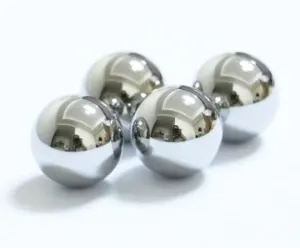
G5,G10,G16 Our Chrome ball usually produce according to GBT 308.1-2013 and ISO 3290-1:2014 standards. Hardness will be customized base on your requirement.
https://www.bearingroller.com/rolling-elements/steel-ball/metal-1ball.html
Contact Us:
Tel: +8615937969996
Email: info@w-bm.com
Website: www.bearingroller.com