
What is the weight of a metal ball? That's a question I get asked a lot as a metal ball supplier. And it's not as straightforward as you might think. There are several factors that can affect the weight of a metal ball, and in this blog post, I'm going to break them down for you.
First off, let's talk about the type of metal. Different metals have different densities, which is a measure of how much mass is packed into a given volume. For example, steel is a commonly used metal for balls, and it has a density of about 7.85 grams per cubic centimeter. On the other hand, aluminum has a much lower density of around 2.7 grams per cubic centimeter. So, if you have two balls of the same size, one made of steel and the other of aluminum, the steel ball is going to be significantly heavier.
Another important factor is the size of the ball. The volume of a sphere (which is what a ball is) is calculated using the formula V = (4/3)πr³, where r is the radius of the ball. As you can see from this formula, the volume of a ball increases exponentially with its radius. That means that even a small increase in the size of a ball can lead to a big increase in its weight. For instance, if you double the radius of a steel ball, its volume will increase by a factor of 8 (since 2³ = 8), and so will its weight.
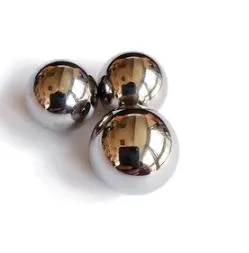
Let's look at some real - world examples to illustrate this. Suppose you're in the market for Large Steel Ball. A small steel ball with a radius of 1 centimeter has a volume of V = (4/3)π(1)³ ≈ 4.19 cubic centimeters. Using the density of steel (7.85 g/cm³), the weight of this ball would be approximately 4.19 × 7.85 = 32.9 grams. Now, if you consider a larger steel ball with a radius of 5 centimeters, its volume is V = (4/3)π(5)³ ≈ 523.6 cubic centimeters. The weight of this larger ball would be about 523.6 × 7.85 = 4100.26 grams or 4.1 kilograms. That's a huge difference!
Precision is also a key aspect when it comes to metal balls. Precision Steel Balls are often used in applications where accuracy is crucial, such as in bearings or measuring instruments. These balls are manufactured to very tight tolerances, which means that their size and weight are highly consistent. This consistency is important because it ensures that the balls will perform as expected in their intended applications.
In addition to size and type of metal, the manufacturing process can also have an impact on the weight of a metal ball. For example, if a ball is cast, there might be some porosity or inclusions in the metal, which can slightly reduce its density and therefore its weight. On the other hand, a forged ball is usually more dense and uniform, resulting in a more predictable weight.
Standards are another thing to consider. Din 5401 Steel Ball are manufactured according to the DIN 5401 standard, which specifies certain requirements for the size, hardness, and other properties of the balls. This standardization helps to ensure that the balls meet a certain level of quality and performance. And when it comes to weight, the standard also provides some guidelines, so you can have a better idea of what to expect.
Now, you might be wondering why knowing the weight of a metal ball is so important. Well, in many industries, the weight of a component can have a significant impact on the overall performance of a system. For example, in aerospace applications, every gram counts, and using lighter metal balls can help to reduce the weight of an aircraft, which in turn can improve fuel efficiency. In the automotive industry, the weight of metal balls in bearings can affect the smoothness of operation and the durability of the vehicle.
As a metal ball supplier, I understand the importance of providing accurate information about the weight of our products. That's why we have a team of experts who carefully measure and test each batch of balls to ensure that they meet the specified weight requirements. We also use advanced manufacturing techniques to produce balls with consistent weights and high - quality finishes.
If you're in the market for metal balls, whether it's for industrial applications, scientific research, or any other purpose, I encourage you to get in touch with us. We have a wide range of metal balls available in different sizes, materials, and precision levels. Our team is ready to help you find the right product for your needs and provide you with all the information you need about the weight and other properties of our metal balls.
In conclusion, the weight of a metal ball depends on several factors, including the type of metal, the size of the ball, the manufacturing process, and the standards it adheres to. By understanding these factors, you can make more informed decisions when purchasing metal balls. So, don't hesitate to reach out to us if you have any questions or if you're ready to start a purchase. We're here to make your buying experience as smooth and hassle - free as possible.
References
- Physics textbooks on density and volume calculations
- Industry standards for metal ball manufacturing such as DIN 5401
- Technical literature from metal ball manufacturers