
What is the sphericity of stainless steel balls? Well, let me break it down for you. I'm a supplier of stainless steel balls, and I've dealt with these little guys day in and day out. So, I think I've got a pretty good grasp on what sphericity means and why it matters.
First off, let's talk about what sphericity actually is. Sphericity is a measure of how closely a particle - in this case, a stainless steel ball - resembles a perfect sphere. A perfect sphere is like an ideal shape, where every point on the surface is equidistant from the center. In the real world, it's almost impossible to get a ball that's 100% spherical, but we strive for it as much as we can.
The sphericity of a stainless steel ball is super important for a bunch of reasons. In applications where precision is key, like in ball bearings, the closer the ball is to a perfect sphere, the better it will roll. When a ball rolls smoothly, it reduces friction. And less friction means less wear and tear on the bearing components, which in turn increases the lifespan of the whole system.
For example, in high - speed machinery, even a tiny deviation from perfect sphericity can cause vibrations. These vibrations can lead to all sorts of problems, from reduced performance to damage to the machinery itself. So, when you're looking at 316 Stainless Steel Balls, you want to make sure they have a high level of sphericity.
Now, how do we measure the sphericity of stainless steel balls? There are a few ways. One common method is to use a roundness measuring instrument. This device works by rotating the ball on a precision spindle and measuring the distance between the surface of the ball and a fixed reference point at multiple locations around the ball. The data collected is then analyzed to calculate the sphericity.
Another way is through visual inspection, although this is less accurate. With the help of a microscope and some trained eyes, we can look for obvious irregularities on the surface of the ball. But this method is more of a quick check, and it's best used in combination with more precise measurement techniques.
As a supplier, I know that different applications require different levels of sphericity. For general industrial use, the requirements might not be as strict. But for high - end applications like aerospace or medical equipment, the standards are much higher.
In aerospace, for instance, the components need to be extremely reliable. A stainless steel ball with poor sphericity could cause a malfunction in a critical system, which is just not acceptable. That's why we offer Solid Steel Balls that meet the most stringent sphericity requirements for these types of applications.
When it comes to the manufacturing process, getting a high - sphericity ball is no easy feat. It starts with the raw materials. We use high - quality stainless steel alloys that have the right properties to be shaped into balls. Then, the balls go through a series of machining operations. First, they're rough - turned to get close to the desired size. After that, they go through a grinding process, which is crucial for improving the sphericity.
During grinding, the balls are placed between two grinding plates that rotate in opposite directions. As the plates move, they gradually wear down the surface of the balls, making them more spherical. This process has to be carefully controlled, as any imbalance or improper pressure can lead to uneven wear and a lower sphericity.
Next comes the lapping process. Lapping is like a final polishing step. It uses a fine abrasive and a lapping plate to further refine the surface of the ball and improve its sphericity even more. After lapping, the balls are thoroughly cleaned and inspected to make sure they meet the required standards.
It's also worth mentioning that the sphericity of stainless steel balls can be affected by external factors. For example, if the balls are stored in a humid environment, they might start to corrode. Corrosion can cause pitting on the surface of the ball, which will definitely reduce its sphericity. So, proper storage is essential to maintain the quality of the balls.
Now, let's compare stainless steel balls with Carbon Steel Ball. Carbon steel balls are also widely used, but they have some differences when it comes to sphericity. Stainless steel is more corrosion - resistant, which means it can maintain its sphericity better over time, especially in harsh environments. Carbon steel, on the other hand, is more prone to rusting, and rust can quickly degrade the surface of the ball and its sphericity.
In terms of hardness, stainless steel balls are often harder than carbon steel balls. This hardness can be an advantage in applications where the balls are subjected to high loads. A harder ball is less likely to deform, which helps to maintain its sphericity under pressure.
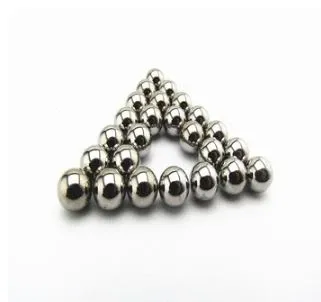
As a supplier, I'm always looking for ways to improve the sphericity of our stainless steel balls. We invest in the latest technology and equipment to ensure that we can produce balls with the highest possible quality. We also have a strict quality control system in place to check every batch of balls before they leave our facility.
If you're in the market for stainless steel balls, whether it's for a small project or a large - scale industrial application, I'd love to talk to you. The sphericity of the balls can have a huge impact on the performance of your product, so it's important to get it right. Don't hesitate to reach out to discuss your specific requirements. We can work together to find the perfect stainless steel balls for your needs.
References
- Smith, J. (2018). "Precision Manufacturing of Metal Balls". Industrial Manufacturing Journal.
- Brown, A. (2019). "The Importance of Sphericity in Ball Bearings". Mechanical Engineering Review.