
In the realm of industrial manufacturing, steel balls are ubiquitous components with a vast array of applications. From precision machinery to automotive parts, these tiny spheres play a crucial role in ensuring the smooth operation and durability of various equipment. One of the most important quality parameters of steel balls is their roundness. But what exactly is the roundness of steel balls, and why is it so important? As a leading steel ball supplier, I'm here to dive into the details and shed light on this critical aspect of steel ball quality.
Understanding Roundness
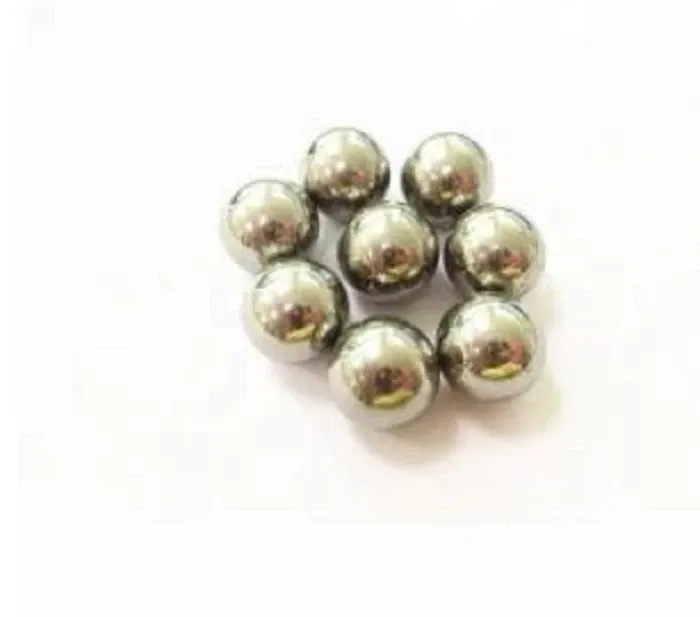
Roundness is a geometric property that describes how closely a three - dimensional object approaches a perfect sphere. In the case of steel balls, it is a measure of the deviation of the ball's actual shape from an ideal, mathematically perfect spherical form. A perfectly round steel ball would have no deviation, meaning that every point on its surface would be equidistant from its center.
However, in real - world manufacturing, achieving absolute roundness is virtually impossible. There are always minor deviations due to factors such as the manufacturing process, raw material quality, and the precision of the production equipment. These deviations can be classified into various types, including out - of - roundness, waviness, and surface roughness, all of which contribute to the overall non - roundness of the steel ball.
Measuring Roundness
To quantify the roundness of steel balls, several measurement techniques are available. One of the most common methods is the use of a roundness measuring instrument, which typically consists of a precision spindle, a probe, and a data - acquisition system. The steel ball is placed on the spindle, which rotates it at a constant speed. As the ball rotates, the probe scans the surface of the ball and measures the distance between the probe and the ball's surface at multiple points.
The data collected by the probe is then analyzed using sophisticated algorithms to calculate the roundness error. The roundness error is usually expressed as a numerical value, often in micrometers (μm). Smaller roundness error values indicate a higher degree of roundness. For example, in high - precision applications, such as ball bearings used in aerospace or medical devices, a roundness error of less than 0.1 μm may be required.
Importance of Roundness in Steel Balls
The roundness of steel balls has a profound impact on their performance and the performance of the equipment in which they are used.
1. Friction and Wear
In applications where steel balls are used as rolling elements, such as in ball bearings, a high degree of roundness is essential to reduce friction. When a non - round ball rolls, it experiences uneven contact with the raceway, which can lead to increased friction and wear. Over time, this can cause premature failure of the bearing, resulting in increased maintenance costs and downtime. A round steel ball, on the other hand, distributes the load evenly across its surface, minimizing friction and wear and extending the service life of the bearing.
2. Precision and Accuracy
In precision machinery, such as optical instruments or semiconductor manufacturing equipment, the roundness of steel balls directly affects the precision and accuracy of the equipment. For example, in a ball - screw drive system, the roundness of the balls determines the smoothness of the linear motion and the accuracy of the positioning. If the balls are not round enough, the system may experience erratic movement, backlash, or reduced repeatability, which can significantly affect the quality of the manufactured products.
3. Noise and Vibration
Non - round steel balls can also cause noise and vibration in equipment. When a non - round ball rotates, it creates an uneven force distribution, which can lead to vibrations. These vibrations can be transmitted through the equipment, causing noise and potentially affecting the performance of other components. In applications where quiet operation is required, such as in household appliances or office equipment, using steel balls with high roundness is crucial to reduce noise and vibration levels.
Our Steel Ball Products and Roundness
As a steel ball supplier, we understand the importance of roundness in steel balls. That's why we offer a wide range of high - quality steel balls, including Carbon Steel Ball, Din 5401 Steel Ball, and Stainless Steel Ball, all manufactured to meet the highest roundness standards.
Our manufacturing process combines advanced technology with strict quality control measures to ensure that each steel ball meets the required roundness specifications. We start with high - quality raw materials and use state - of - the - art forging, grinding, and polishing techniques to shape the balls. After the manufacturing process, each ball undergoes rigorous roundness testing using the latest measurement equipment. Only the balls that meet our strict roundness criteria are approved for shipment.
Applications of Our High - Roundness Steel Balls
Our high - roundness steel balls find applications in a wide range of industries:
1. Automotive Industry
In the automotive industry, our steel balls are used in ball joints, steering systems, and transmissions. High roundness ensures smooth operation, reduces friction and wear, and improves the overall performance and safety of the vehicle.
2. Aerospace Industry
The aerospace industry demands the highest level of precision and reliability. Our steel balls with excellent roundness are used in aircraft engines, landing gear systems, and flight control mechanisms, where any deviation from the ideal shape can have serious consequences.
3. Industrial Machinery
In industrial machinery, such as machine tools and robotics, our steel balls are used in ball screws, linear guides, and bearings. The high roundness of our balls ensures precise motion control, high efficiency, and long - term reliability.
Contact Us for Your Steel Ball Needs
If you are in the market for high - quality steel balls with excellent roundness, look no further. We are committed to providing our customers with the best products and services. Our team of experts is always ready to help you select the right steel balls for your specific application. Whether you need a small quantity for a prototype or a large volume for mass production, we can meet your requirements.
To start a conversation about your steel ball needs, simply reach out to us. We will be happy to discuss the details, provide you with samples if needed, and offer competitive pricing. Your success is our success, and we look forward to partnering with you.
References
- ISO 3290 - 1:2018, Rolling bearings — Ball bearings — Tolerances — Part 1: Tolerances for steel balls
- DIN 5401:2007 - 07, Test and working pieces for shape measuring instruments; concepts, requirements, testing
- Harris, T. A., & Kotzalas, M. N. (2007). Rolling Bearing Analysis (4th ed.). Wiley.