
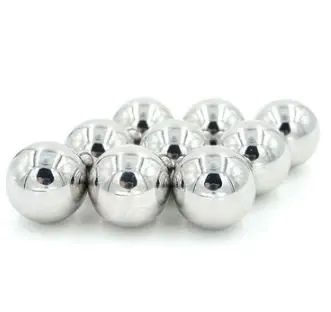
Solid steel balls are widely used in various industries, from automotive to aerospace, due to their excellent mechanical properties. One of the less - discussed but equally important characteristics of solid steel balls is their electrical conductivity. As a solid steel balls supplier, I've had numerous inquiries about this property, and in this blog, I'll delve into the electrical conductivity of solid steel balls.
Understanding Electrical Conductivity
Before we discuss the electrical conductivity of solid steel balls, it's essential to understand what electrical conductivity is. Electrical conductivity, denoted by the symbol σ (sigma), is a measure of a material's ability to conduct an electric current. It is the reciprocal of electrical resistivity (ρ), which is a measure of how strongly a material opposes the flow of electric current. The SI unit of electrical conductivity is siemens per meter (S/m).
Materials can be classified into conductors, semiconductors, and insulators based on their electrical conductivity. Conductors, such as metals, have high electrical conductivity, allowing electric charges to move freely through them. Semiconductors have intermediate conductivity, and insulators have very low conductivity, making it difficult for electric charges to flow.
Factors Affecting the Electrical Conductivity of Solid Steel Balls
The electrical conductivity of solid steel balls is influenced by several factors:
1. Composition of the Steel
Steel is an alloy primarily composed of iron and carbon, with small amounts of other elements such as manganese, silicon, sulfur, and phosphorus. The exact composition of the steel can significantly affect its electrical conductivity. For example, Carbon Steel Ball typically has a relatively high carbon content, which can reduce its electrical conductivity compared to pure iron. This is because carbon atoms disrupt the regular lattice structure of iron, making it more difficult for electrons to move through the material.
Other alloying elements can also have an impact. For instance, adding chromium to steel can improve its corrosion resistance but may also slightly reduce its electrical conductivity. On the other hand, some elements like copper can increase the electrical conductivity when added in small amounts.
2. Microstructure
The microstructure of the steel, which is determined by factors such as heat treatment and cooling rate, also plays a crucial role in electrical conductivity. A fine - grained microstructure generally has higher electrical conductivity than a coarse - grained one. This is because grain boundaries act as barriers to electron movement. In a fine - grained material, the electrons have to cross more grain boundaries, but the overall effect on conductivity is less severe compared to a coarse - grained material where the grain boundaries are larger and more widely spaced.
3. Temperature
Like most metals, the electrical conductivity of solid steel balls decreases with increasing temperature. This is due to the increased thermal vibration of the atoms in the lattice. As the temperature rises, the atoms vibrate more vigorously, which scatters the electrons and makes it more difficult for them to flow through the material.
Measuring the Electrical Conductivity of Solid Steel Balls
There are several methods to measure the electrical conductivity of solid steel balls. One common method is the four - point probe technique. In this method, four probes are placed in contact with the surface of the steel ball. A known current is passed through the outer two probes, and the voltage is measured across the inner two probes. Using Ohm's law (V = IR), the resistance of the material can be calculated, and from the resistance, the electrical conductivity can be determined.

Another method is the eddy - current testing method. This non - destructive testing technique uses an alternating magnetic field to induce eddy currents in the steel ball. The magnitude and phase of the eddy currents are affected by the electrical conductivity of the material. By measuring these parameters, the electrical conductivity of the steel ball can be estimated.
Typical Values of Electrical Conductivity for Solid Steel Balls
The electrical conductivity of solid steel balls can vary widely depending on their composition and other factors. Generally, the electrical conductivity of carbon steel balls ranges from about 1×10⁶ S/m to 5×10⁶ S/m. Stainless steel balls, which have a different composition and are more corrosion - resistant, typically have a lower electrical conductivity, in the range of 0.5×10⁶ S/m to 2×10⁶ S/m.
Applications Related to Electrical Conductivity
The electrical conductivity of solid steel balls is relevant in several applications:
1. Electrical Switches and Connectors
In some electrical switches and connectors, solid steel balls can be used as contact elements. Their electrical conductivity allows for the efficient transfer of electric current between different parts of the circuit. The high mechanical strength of steel balls also ensures that they can withstand the mechanical stresses associated with repeated switching operations.
2. Electro - magnetic Actuators
In electro - magnetic actuators, steel balls can be used to transmit mechanical forces generated by the interaction of magnetic fields and electric currents. The electrical conductivity of the steel balls is important for the efficient operation of these actuators, as it affects the strength of the magnetic fields and the response time of the system.
3. Electrical Discharge Machining (EDM)
In EDM, solid steel balls can be used as electrodes. The electrical conductivity of the steel balls is crucial for the generation of electrical discharges, which are used to remove material from the workpiece. A higher electrical conductivity allows for more efficient material removal and better machining accuracy.
Our Offerings as a Solid Steel Balls Supplier
As a solid steel balls supplier, we offer a wide range of Carbon Steel Ball and Metal Ball products with different compositions and electrical conductivities to meet the diverse needs of our customers. We have a strict quality control system in place to ensure that our steel balls meet the highest standards in terms of both mechanical and electrical properties.
Whether you need steel balls for electrical applications or other industrial uses, we can provide you with the right products. Our technical team is also available to offer advice on the selection of the most suitable steel balls based on your specific requirements regarding electrical conductivity and other factors.
Contact Us for Procurement
If you are interested in purchasing solid steel balls and want to discuss your specific needs regarding electrical conductivity or other properties, we encourage you to get in touch with us. We are committed to providing you with high - quality products and excellent customer service. Our team will work closely with you to understand your requirements and provide you with the best solutions.
References
- Callister, W. D., & Rethwisch, D. G. (2010). Materials Science and Engineering: An Introduction. Wiley.
- Askeland, D. R., & Phulé, P. P. (2010). The Science and Engineering of Materials. Cengage Learning.
- Van Vlack, L. H. (1989). Elements of Materials Science and Engineering. Addison - Wesley.