
Hey there! As a supplier of Stainless Steel Balls, I often get asked about the elastic modulus of these little spherical wonders. So, let's dive right in and explore what the elastic modulus of stainless steel balls is all about.
First off, what exactly is the elastic modulus? Well, in simple terms, it's a measure of how stiff a material is. When you apply a force to an object, it deforms. The elastic modulus tells you how much the object will deform under that force, as long as the force is within the elastic range of the material. In other words, it's the ratio of stress (force per unit area) to strain (the amount of deformation) in the elastic region.
For stainless steel balls, the elastic modulus is a crucial property. It affects how the balls perform in various applications. For example, in ball bearings, the elastic modulus determines how well the balls can withstand the loads and maintain their shape. If the elastic modulus is too low, the balls may deform too much under load, leading to premature wear and failure. On the other hand, if it's too high, the balls may be too brittle and prone to cracking.
The elastic modulus of stainless steel balls can vary depending on several factors. One of the main factors is the type of stainless steel used. There are different grades of stainless steel, each with its own unique chemical composition and properties. For instance, austenitic stainless steels, such as 304 and 316, are known for their good corrosion resistance and relatively high elastic modulus. Ferritic and martensitic stainless steels have different properties and may have a different elastic modulus.
Another factor that can affect the elastic modulus is the manufacturing process. The way the stainless steel balls are made, including the heat treatment and cold working processes, can influence their microstructure and, consequently, their elastic modulus. For example, cold working can increase the strength and hardness of the balls, which may also affect the elastic modulus.
Typically, the elastic modulus of stainless steel balls ranges from about 190 GPa to 210 GPa. This value can be used as a general guideline, but it's important to note that the actual elastic modulus may vary depending on the specific grade of stainless steel and the manufacturing process.
Now, let's talk about the applications of stainless steel balls and how the elastic modulus comes into play. As I mentioned earlier, ball bearings are one of the most common applications. In ball bearings, the stainless steel balls roll between the inner and outer races, reducing friction and allowing smooth rotation. The elastic modulus of the balls helps to ensure that they can withstand the radial and axial loads without excessive deformation.
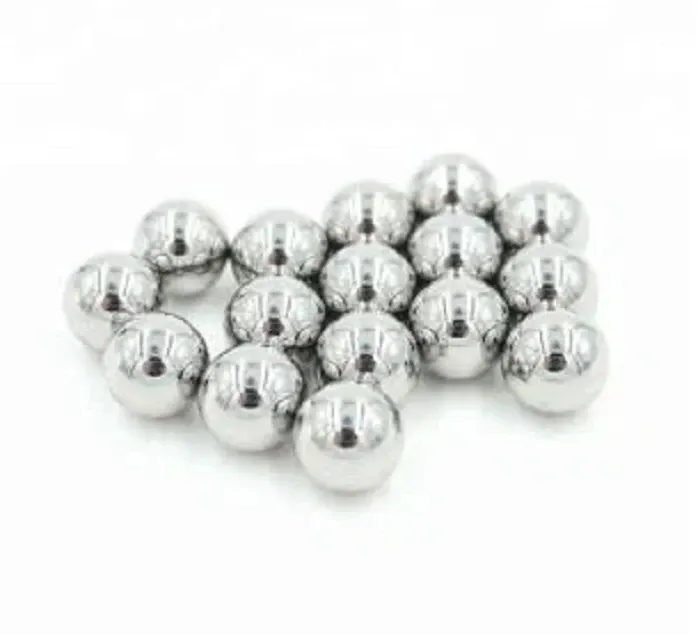
Stainless steel balls are also used in valves, pumps, and other fluid handling equipment. In these applications, the balls act as seals or check valves, controlling the flow of fluids. The elastic modulus is important here because it affects the sealing performance of the balls. A ball with the right elastic modulus will be able to form a tight seal against the valve seat, preventing leakage.
In addition, stainless steel balls are used in jewelry, art, and other decorative applications. While the elastic modulus may not be as critical in these applications as it is in mechanical ones, it still plays a role in determining the durability and quality of the finished product.
As a supplier of Stainless Steel Balls, I offer a wide range of products to meet the diverse needs of my customers. Whether you're looking for Metric Steel Ball for precision applications or Large Steel Ball for heavy-duty use, I've got you covered. You can check out my Stainless Steel Ball offerings on my website.
If you're in the market for stainless steel balls and have any questions about the elastic modulus or other properties, don't hesitate to reach out. I'm here to help you find the right product for your specific application. Whether you're a small business or a large corporation, I can provide you with high-quality stainless steel balls at competitive prices.
In conclusion, the elastic modulus of stainless steel balls is an important property that affects their performance in various applications. By understanding this property and how it relates to the type of stainless steel and the manufacturing process, you can make an informed decision when choosing the right balls for your needs. So, if you're looking for top-notch stainless steel balls, give me a shout, and let's start a conversation about your requirements.
References
- Callister, W. D., & Rethwisch, D. G. (2010). Materials Science and Engineering: An Introduction. Wiley.
- ASM Handbook Volume 1: Properties and Selection: Irons, Steels, and High-Performance Alloys. ASM International.