
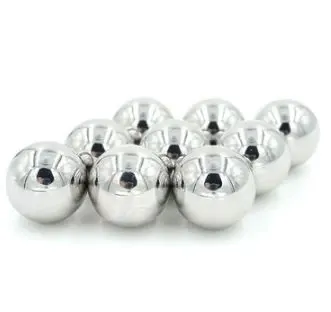
Yo, fellow industry peeps! Today, I'm gonna chat about the cool applications of stainless steel balls in the optical industry. As a stainless steel ball supplier, I've seen firsthand how these little spherical wonders play a big role in this high - tech field.
1. Precision Optics Assembly
In the world of precision optics, every tiny detail matters. Stainless steel balls are used in the assembly of optical components. For example, when aligning lenses in a complex optical system, these balls act as spacers. They ensure that the lenses are placed at the exact right distance from each other. This is super important because even a small misalignment can cause significant problems in the optical performance, like blurry images or inaccurate light focusing.
The high precision and roundness of our stainless steel balls are key here. We manufacture them to extremely tight tolerances, so they can provide the reliable and consistent spacing that precision optics require. And because stainless steel is resistant to corrosion, the balls won't rust or degrade over time, which is crucial for the long - term stability of the optical system.
2. Optical Instrumentation and Metrology
Optical instrumentation and metrology involve measuring and analyzing light and its properties. Stainless steel balls are used in various measuring devices. Take interferometers, for instance. These are used to measure surface flatness, distance, and other optical parameters with extremely high accuracy.
The balls are used as reference points or as part of the mechanical structure of the instrument. Their smooth surface and high hardness make them ideal for this purpose. When used as reference points, they provide a stable and well - defined position for the measurement. And in the mechanical structure, they help to ensure the instrument's stability and precision.
3. Lens Grinding and Polishing
Lens grinding and polishing are essential steps in the production of optical lenses. Stainless steel balls are used in the grinding and polishing machines. They act as abrasive media in some cases. When mixed with abrasive compounds, they help to shape and smooth the lens surface.
The size and hardness of the stainless steel balls can be carefully selected according to the specific requirements of the lens manufacturing process. Smaller balls are often used for finer polishing, while larger ones can be used for more aggressive grinding. Our company offers a wide range of ball sizes, so manufacturers can choose the most suitable ones for their needs.
4. Optical Switching Systems
Optical switching systems are used to route optical signals in fiber - optic communication networks. Stainless steel balls are used in the mechanical components of these switches. They are used in the actuators that move the optical elements, such as mirrors or prisms, to change the path of the light signal.
The high strength and durability of stainless steel balls make them reliable for these applications. They can withstand the repeated mechanical movements and forces involved in the switching process without deforming or wearing out quickly. This ensures the long - term performance and reliability of the optical switching systems.
5. Comparison with Other Types of Balls
Now, you might be wondering how stainless steel balls stack up against other types of balls. Let's take a quick look at Carbon Steel Ball and Din 5401 Steel Ball.
Carbon steel balls are cheaper than stainless steel balls, but they are more prone to corrosion. In the optical industry, where long - term stability and performance are crucial, the corrosion resistance of stainless steel balls gives them a big advantage.
Din 5401 steel balls are made to a specific standard. While they have their own advantages in terms of precision and quality, stainless steel balls offer the additional benefit of corrosion resistance. This makes them more suitable for optical applications where the environment might be humid or where the components need to last a long time without degradation.
6. Our Company's Offerings
As a stainless steel ball supplier, we take pride in our products. We have a state - of - the - art manufacturing facility that allows us to produce high - quality stainless steel balls with excellent precision and surface finish.
We offer a wide range of ball sizes, from very small ones used in micro - optical components to larger ones for more heavy - duty applications. Our quality control process is rigorous, ensuring that every ball meets the highest standards.
We also provide custom - made solutions. If you have specific requirements for the size, hardness, or surface finish of the stainless steel balls, we can work with you to develop the perfect product for your optical application.
7. Why Choose Us
There are several reasons why you should choose our company as your stainless steel ball supplier. First of all, our products are of the highest quality. We use the best raw materials and the latest manufacturing techniques to ensure that our balls are reliable and perform well.
Secondly, we have a great customer service team. We are always ready to answer your questions and provide you with technical support. Whether you need help choosing the right ball for your application or have questions about the manufacturing process, we're here to assist you.
Finally, we offer competitive pricing. We understand that cost is an important factor in your decision - making process, so we strive to provide high - quality products at a reasonable price.
8. Let's Connect!
If you're in the optical industry and are looking for a reliable stainless steel ball supplier, I'd love to hear from you. Whether you're working on a small - scale research project or a large - scale production line, we can provide the stainless steel balls you need.
Don't hesitate to reach out to us for more information or to discuss your specific requirements. We're eager to work with you and help you achieve the best results in your optical applications.
References
- "Optical Engineering Handbook" - A comprehensive guide on optical engineering principles and applications.
- Industry reports on the use of materials in optical manufacturing.
- Technical documents from our own manufacturing processes and quality control procedures.