
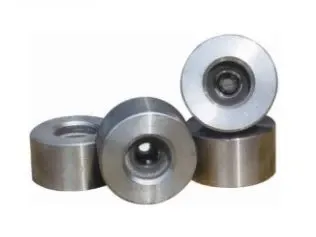
Hey there! As a supplier of Tungsten Carbide Dies, I often get asked about how to test the performance of a newly - purchased tungsten carbide die. It's a crucial step, because you want to make sure you're getting the best bang for your buck and that the die will serve you well in your production processes.
First off, let's talk about why performance testing is so important. Tungsten carbide dies are used in a variety of industries, from automotive to aerospace, for tasks like cold heading, wire drawing, and extrusion. A high - performing die can increase productivity, reduce waste, and save you money in the long run. On the other hand, a poorly performing die can lead to defective products, downtime, and additional costs.
Visual Inspection
The first step in testing a newly - purchased tungsten carbide die is a visual inspection. Take a close look at the die with a magnifying glass or under a microscope if possible. Check for any visible cracks, chips, or uneven surfaces. These defects can significantly affect the die's performance and may cause premature failure. You should also look at the surface finish. A smooth and uniform surface is a good sign, as it indicates proper manufacturing processes. Rough or pitted surfaces can cause friction and wear during use.
Dimensional Accuracy
Dimensional accuracy is another critical factor. You need to ensure that the die meets the specified dimensions. Use precision measuring tools like calipers, micrometers, or coordinate measuring machines (CMMs). Measure the key dimensions such as the diameter, length, and wall thickness. Compare the measured values with the design specifications. Even a small deviation can lead to problems, such as incorrect part sizes or poor fit. If the die is for a specific application, like making a particular type of fastener, make sure the dimensions are spot - on to produce parts that meet the required standards.
Hardness Testing
Tungsten carbide is known for its high hardness, which is one of the reasons it's so popular for dies. Hardness testing can be done using a hardness tester. There are different methods, such as the Rockwell or Vickers hardness tests. A higher hardness generally means better wear resistance, but it also needs to be balanced with toughness. If the die is too hard, it may be brittle and prone to cracking under stress. A proper hardness test can give you an idea of how well the die will withstand the forces during its intended use.
Compression Testing
Compression testing is a great way to evaluate the die's strength. In this test, a controlled force is applied to the die to see how it responds. The die should be able to withstand a certain amount of pressure without deforming or breaking. This is especially important for dies used in high - pressure applications like cold heading. You can use a hydraulic press or a specialized compression testing machine. Record the maximum force the die can handle before any signs of damage appear. This data can help you determine if the die is suitable for your specific production requirements.
Wear Testing
Wear is a major concern when it comes to tungsten carbide dies. To test the wear resistance, you can perform a wear test. One common method is to use a test piece made of the same material that the die will be working with in actual production. Run the test piece through the die multiple times and measure the amount of wear on the die surface. You can use techniques like profilometry to measure the surface roughness changes over time. A die with good wear resistance will show minimal wear even after a large number of cycles.
Thermal Testing
In some applications, the die may be exposed to high temperatures. Thermal testing can help you understand how the die will perform under these conditions. You can heat the die to a specific temperature and measure its dimensional stability and hardness changes. Thermal expansion can cause the die to change shape, which can affect the part quality. By performing thermal tests, you can ensure that the die will maintain its performance even in high - temperature environments.
Function Testing
Finally, the best way to test the die's performance is to use it in a real - world application. Run a small batch of production parts using the newly - purchased die. Inspect the parts for quality, such as their dimensions, surface finish, and mechanical properties. Check if the parts meet the required standards. If there are any issues, like burrs, cracks, or incorrect sizes, it could indicate a problem with the die. Analyze the results and make any necessary adjustments or replacements.
Now, if you're in the market for high - quality Tungsten Carbide Dies, we've got you covered. Our dies are carefully manufactured to meet the highest standards of quality and performance. We also offer a range of related products like Quill COD and Carbide Cut Off Blade COB. You can check out our Tungsten Carbide Die page for more details on our product offerings.
If you have any questions or want to discuss your specific needs, feel free to reach out. We're always happy to help you find the right die for your application and ensure that you get the best performance possible.
References
- "Handbook of Tungsten Carbide and Hard Materials" by R. Kieffer and F. Benesovsky
- "Manufacturing Engineering and Technology" by S. Kalpakjian and S. Schmid