
As a supplier of inch steel balls, determining the quality grade of these products is crucial for both the manufacturer and the customer. In the following, I'll discuss the key factors and methods to determine the quality grade of inch steel balls.
Material Quality
The quality of the material used to make inch steel balls is fundamental. Different types of steel have distinct properties that affect the performance of the steel balls.
Stainless Steel Ball
Stainless steel is a popular choice for steel balls due to its corrosion - resistance. Stainless Steel Ball offers excellent durability in harsh environments. High - quality stainless steel for steel balls should have a uniform chemical composition. The percentage of elements such as chromium, nickel, and molybdenum must be within a specific range. For example, austenitic stainless steels typically contain 16 - 26% chromium and 6 - 22% nickel. Any deviation from the standard composition can lead to reduced corrosion resistance and mechanical properties.
Metal Ball
Metal Ball can be made from various metals, and the purity of the metal is a critical factor. Impurities in the metal can cause internal defects in the steel balls. For instance, sulfur and phosphorus are common impurities in metals. High levels of sulfur can lead to hot brittleness, while excessive phosphorus can cause cold brittleness. These defects can significantly reduce the strength and toughness of the steel balls.
Carbon Steel Ball
Carbon Steel Ball is another widely used material. The carbon content in carbon steel directly affects its hardness and strength. Low - carbon steel (less than 0.3% carbon) is relatively soft and ductile, suitable for applications where high - impact resistance is required. Medium - carbon steel (0.3 - 0.6% carbon) offers a good balance between hardness and toughness. High - carbon steel (more than 0.6% carbon) is very hard but may be brittle. Therefore, for carbon steel balls, accurately controlling the carbon content is essential to achieve the desired quality grade.
Dimensional Accuracy
Dimensional accuracy is a key aspect of determining the quality grade of inch steel balls. The diameter of the steel ball is one of the most important dimensions. Even a small deviation from the specified diameter can cause problems in applications such as bearings.
Diameter Tolerance
The tolerance of the diameter is strictly regulated. For high - precision applications, the diameter tolerance can be as small as a few micrometers. For example, in some high - end automotive bearings, the diameter tolerance of the steel balls may be within ± 0.002mm. Measuring the diameter of steel balls can be done using precision measuring tools such as micrometers or optical measuring devices.
Sphericity
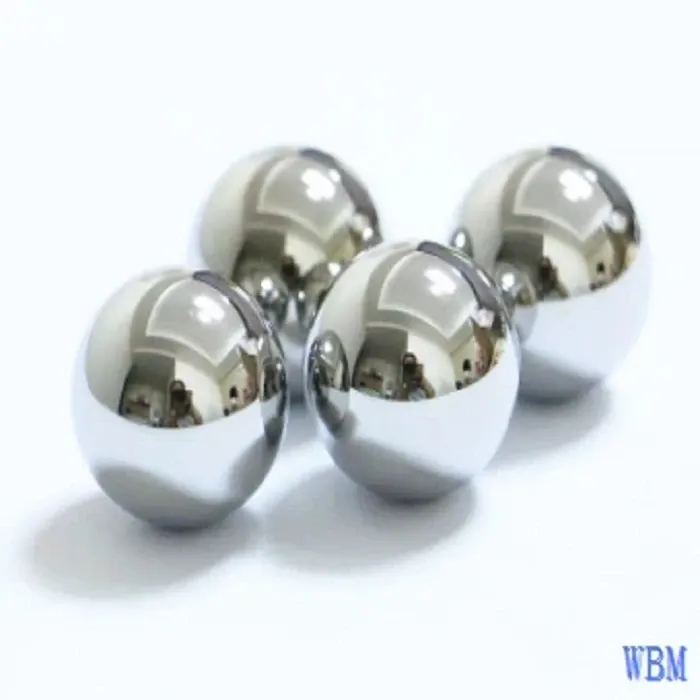
Sphericity refers to how closely the shape of the steel ball approximates a perfect sphere. Imperfections in sphericity can lead to uneven wear and reduced performance. To measure sphericity, advanced measuring equipment such as roundness testers is used. High - quality inch steel balls should have a very high degree of sphericity, with the deviation from a perfect sphere being extremely small.
Surface Finish
The surface finish of inch steel balls has a significant impact on their performance. A smooth surface can reduce friction and wear, while a rough surface can cause premature failure.
Surface Roughness
Surface roughness is measured in terms of the average height of the surface irregularities. For high - performance applications, the surface roughness of steel balls should be very low. For example, in precision ball bearings, the surface roughness may be required to be less than 0.02μm. Surface roughness can be measured using profilometers.
Surface Defects
Surface defects such as cracks, pits, and scratches can also affect the quality of steel balls. These defects can act as stress concentration points, leading to fatigue failure. Visual inspection and non - destructive testing methods such as magnetic particle inspection or ultrasonic testing are commonly used to detect surface defects.
Hardness and Toughness
The hardness and toughness of inch steel balls are important mechanical properties.
Hardness
Hardness determines the resistance of the steel ball to indentation and wear. Different applications require different hardness levels. For example, in high - load applications, steel balls with high hardness are needed. Hardness can be measured using methods such as the Rockwell hardness test or the Vickers hardness test.
Toughness
Toughness is the ability of the steel ball to absorb energy and resist fracture. A balance between hardness and toughness is necessary. If the steel ball is too hard, it may be brittle and prone to cracking. On the other hand, if it is too soft, it will wear out quickly. Impact testing methods can be used to evaluate the toughness of steel balls.
Testing and Certification
To ensure the quality grade of inch steel balls, comprehensive testing and certification are necessary.
In - house Testing
As a supplier, we conduct in - house testing on every batch of steel balls. This includes material analysis, dimensional measurement, surface inspection, and mechanical property testing. By performing these tests, we can identify any potential quality issues early in the production process.
Third - party Certification
In addition to in - house testing, we also seek third - party certification. Independent testing laboratories can provide objective and reliable evaluation of the quality of our steel balls. Certifications such as ISO 9001 and ISO 14001 demonstrate our commitment to quality and environmental management.
Conclusion
Determining the quality grade of inch steel balls involves a comprehensive assessment of multiple factors, including material quality, dimensional accuracy, surface finish, hardness, and toughness. As a professional supplier of inch steel balls, we are committed to providing high - quality products that meet the strictest industry standards.
If you are in the market for high - quality inch steel balls, we invite you to contact us for procurement and further discussions. We have a wide range of products to meet your specific needs, and our experienced team can provide you with professional advice and support.
References
- ASM Handbook Volume 1: Properties and Selection: Irons, Steels, and High - Performance Alloys. ASM International.
- ISO 3290 - 1:2018 Rolling bearings - Steel balls - Part 1: Tolerances. International Organization for Standardization.
- ASTM A295/A295M - 18 Standard Specification for Steel Castings, Carbon, for General Application. American Society for Testing and Materials.