
Hey there! As a supplier of large steel balls, I often get asked, "How much does a large steel ball weigh?" It's a pretty common question, and the answer isn't as straightforward as you might think. In this blog post, I'm gonna break down the factors that affect the weight of a large steel ball and give you a better understanding of how to calculate it.
First off, let's talk about the basics. The weight of a steel ball depends on two main factors: its size and the density of the steel. The size of a steel ball is usually measured by its diameter, and the density of steel can vary depending on its composition. Most commonly, we use carbon steel or stainless steel for our large steel balls, and the density of these materials is around 7.85 grams per cubic centimeter (g/cm³).
To calculate the weight of a steel ball, we can use the formula for the volume of a sphere, which is V = (4/3)πr³, where V is the volume and r is the radius (half of the diameter). Once we have the volume, we can multiply it by the density of the steel to get the weight.
Let's say we have a large steel ball with a diameter of 10 centimeters. First, we need to find the radius, which is 5 centimeters. Then, we can use the formula to calculate the volume:
V = (4/3)π(5³)
V = (4/3)π(125)
V ≈ 523.6 cm³
Now that we have the volume, we can multiply it by the density of the steel (7.85 g/cm³) to get the weight:
Weight = 523.6 cm³ × 7.85 g/cm³
Weight ≈ 4100 grams or 4.1 kilograms
So, a large steel ball with a diameter of 10 centimeters would weigh approximately 4.1 kilograms.
But what if the steel ball isn't a perfect sphere? Well, in that case, the calculation gets a bit more complicated. We might need to use more advanced methods to measure the volume, such as water displacement or 3D scanning. However, for most practical purposes, the spherical approximation works just fine.
Another factor that can affect the weight of a large steel ball is its surface finish. If the ball has a rough surface, it might have a slightly higher weight due to the extra material on the surface. On the other hand, if the ball is polished, it might be a bit lighter.
Now, let's talk about some real-world applications of large steel balls and how their weight matters. One common use for large steel balls is in ball mills, which are used to grind materials into fine powders. In a ball mill, the steel balls are used as grinding media, and their weight and size determine how effectively they can break down the material. Heavier balls can apply more force, which can lead to faster grinding times.
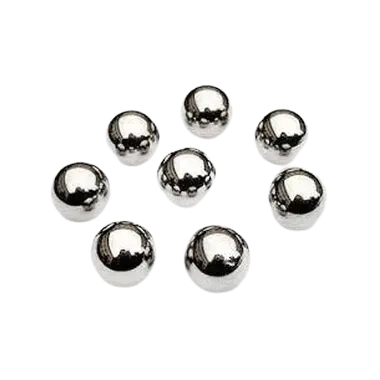
Large steel balls are also used in the manufacturing of Ball Bearing Balls. In this case, the weight and precision of the balls are crucial for ensuring smooth operation and long-lasting performance. Din 5401 Steel Ball are often used in these applications, as they meet specific standards for quality and dimensional accuracy.
In the construction industry, large steel balls can be used as counterweights or in the production of heavy machinery. The weight of the balls is important for maintaining balance and stability. For example, in a crane, the steel balls might be used as part of the counterweight system to prevent the crane from tipping over.
If you're in the market for large steel balls, it's important to consider your specific requirements. Think about the size, weight, and quality of the balls you need for your application. At our company, we offer a wide range of large steel balls, including Din 5401 Steel Ball in various sizes and grades. We can also work with you to custom-manufacture steel balls to meet your exact specifications.
Whether you're a manufacturer, a construction company, or just someone with a unique project, we're here to help. Our team of experts can provide you with all the information you need to make an informed decision. We can also offer competitive pricing and fast delivery times.
If you're interested in learning more about our large steel balls or have any questions about their weight and applications, don't hesitate to get in touch. We'd love to have a chat with you and discuss how we can meet your needs. Just reach out to us, and we'll be happy to assist you in your procurement process.
In conclusion, the weight of a large steel ball depends on its size and the density of the steel. By using the formula for the volume of a sphere and multiplying it by the density, we can calculate the weight. However, it's important to consider other factors such as surface finish and real-world applications. If you're looking for high-quality large steel balls, we're here to be your reliable supplier.
References
- Engineering Toolbox - Density of Metals and Alloys
- Machinery's Handbook