
Yo, folks! As a supplier of Ball Bearing Balls, I've been getting a bunch of questions lately about how these little guys perform in low - temperature environments. So, I thought I'd sit down and share what I know.
First off, let's talk about why low - temperature performance matters. In a lot of industries, like aerospace, automotive in cold regions, and some scientific research equipment, the operating environment can get really cold. And when the temperature drops, the properties of materials change, which can have a big impact on how ball bearing balls work.
One of the key things that happens at low temperatures is that the material's hardness can increase. For most metals used in ball bearing balls, such as steel, as the temperature goes down, the atoms in the metal lattice move less freely. This makes the metal stiffer and harder. Now, on one hand, a harder ball might seem like a good thing. It can resist deformation better under load. But on the other hand, it also becomes more brittle.
Brittleness is a major concern in low - temperature applications. A brittle ball is more likely to crack or shatter when it encounters an impact or sudden load. This can lead to catastrophic failure of the bearing system. For example, in an aircraft's landing gear system, if a ball bearing ball shatters due to low - temperature brittleness, it could cause the entire landing gear to malfunction, which is obviously a huge safety risk.
Another aspect to consider is the coefficient of thermal expansion. Different materials expand and contract at different rates as the temperature changes. In a ball bearing, if the balls and the raceway (the track on which the balls roll) have different coefficients of thermal expansion, it can lead to problems. At low temperatures, the balls might contract more or less than the raceway. If the balls contract more, there could be excessive clearance in the bearing, which can cause noise, vibration, and reduced load - carrying capacity. If they contract less, it could lead to pre - loading of the bearing, increasing friction and wear.
Now, let's take a look at some of the materials we commonly use for ball bearing balls and how they perform in low - temperature environments.
Stainless steel is a popular choice for ball bearing balls. Stainless Steel Ball offers good corrosion resistance, which is important in many applications. 316 stainless steel, in particular, is known for its excellent chemical resistance. 316 Stainless Steel Balls have a relatively stable performance at low temperatures. Their coefficient of thermal expansion is moderate, and they don't become extremely brittle like some other metals. However, as the temperature drops further, they still experience an increase in hardness and a decrease in ductility.
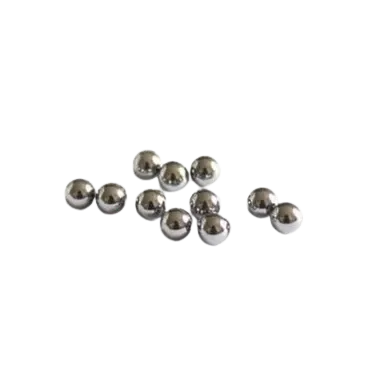

Large steel balls, like those found in Large Steel Ball, are often used in heavy - duty applications. The larger the ball, the more complex the thermal behavior can be. In low - temperature environments, large steel balls need to be carefully designed and heat - treated to ensure uniform cooling and to minimize the risk of internal stresses that could lead to cracking.
Ceramic balls are another option for low - temperature applications. Ceramics have some unique properties that make them suitable for cold environments. They have a very low coefficient of thermal expansion, which means they don't expand or contract much with temperature changes. This can help maintain a more stable bearing clearance. Additionally, ceramics are generally more resistant to brittleness at low temperatures compared to metals. However, they are more expensive and can be more difficult to manufacture.
So, how do we ensure that our ball bearing balls perform well in low - temperature environments? Well, it all starts with the material selection. We carefully choose the right grade of steel or ceramic based on the specific temperature range and application requirements. Then, we use advanced manufacturing processes to control the internal structure of the balls. Heat treatment is a crucial step. By carefully controlling the heating and cooling rates, we can optimize the hardness, ductility, and internal stress distribution of the balls.
We also conduct extensive testing on our ball bearing balls. We simulate low - temperature environments in our labs to measure the performance of the balls under different conditions. We test for hardness, impact resistance, and coefficient of thermal expansion. This allows us to fine - tune our manufacturing processes and ensure that our products meet the highest standards.
In addition to material and manufacturing, proper lubrication is also essential in low - temperature applications. Lubricants can help reduce friction and wear, and they can also protect the balls from corrosion. However, not all lubricants are suitable for low temperatures. Some lubricants can thicken or even solidify at cold temperatures, which can cause problems. We work closely with lubricant suppliers to recommend the right lubricant for each application.
If you're in an industry that requires ball bearing balls to perform in low - temperature environments, you need a reliable supplier. That's where we come in. We've got the expertise and the resources to provide you with high - quality ball bearing balls that are specifically designed for cold conditions. Whether you need 316 Stainless Steel Balls, Large Steel Ball, or Stainless Steel Ball, we can offer you the best solutions.
Don't hesitate to reach out to us if you have any questions or if you're interested in purchasing our products. We're always happy to have a chat and help you find the right ball bearing balls for your needs.
References:
- "Bearing Design in Machinery" by Tedric A. Harris
- "Materials Science and Engineering: An Introduction" by William D. Callister Jr. and David G. Rethwisch